
$2,210.87
Add to Cart
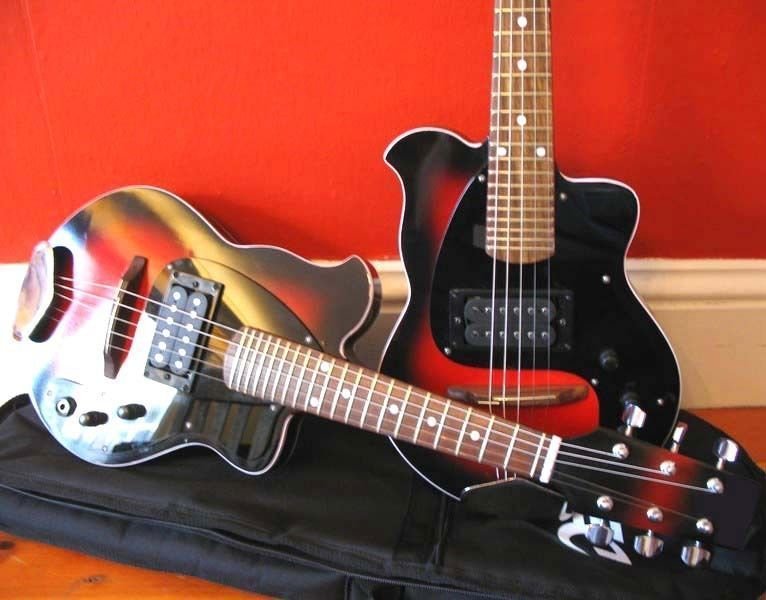
*RARE* U SRINIVAS INDIAN CARNATIC MANDOLINE MANDOLIN FOR PROFESSIONAL PLAYERS
Only 1 available
Details
Shipping: Australia: $18.00 (more destinations)
Condition: Brand new
Returns: 30 days, buyer pays return shipping (more)
5-STRING PROFESSIONAL CARNATIC MANDOLIN - U .SRINIVAS CONFIGURATION + PADDED GIGBAG How is the Carnatic Mandolin different? Mandolin Srinivas (a) chose the electric solid block (Mandolin) as the basis; (b) used single strings instead of pairs, and (c) also added a fifth string (on the suggestion of his father U Satyanarayana), which enhanced the acoustic range of the instrument. As such the acoustic range of the instrument is now three complete octaves and a half octave. Besides the above, U.Srinivas also established a unique style in handling the instrument i.e. developed new fingering techniques and also established the hammer-on playing and also the gamaka playing techniques on the mandolin, all of which required deisgn and form changes from the western style Mandoline. In Indian classical music and Indian light music, the mandolin, which bears little resemblance to the European mandolin, is likely to be tuned to E-B-E-B. As there is no concept of absolute pitch in Indian classical music, any convenient tuning maintaining these relative pitch intervals between the strings can be used. Another prevalent tuning with these intervals is C-G-C-G, which corresponds to Sa-Pa-Sa-Pa in the Indian carnatic classical music style. This tuning corresponds to the way violins are tuned for carnatic classical music. Construction: It usually has four pairs of strings that run over a fretted neck. However, the Indian version of Mandolin, which is not the conventional mandolin, uses just 5 strings. The strings are played with the fingers of the left hand and plucked with a plectrum held in the right hand. Tuning: A few minor changes have been incorporated in the tuning, to suit the requirements of Carnatic music. It is tuned to the pitch of 1 kattai or C. Posture: In accordance with the Indian custom, the artiste sits cross-legged and keeps the instrument across his lap. 1. The use of the truss rod: Truss rod is wedged inside the neck and brings with it the benefit of increased sustenance of notes and greater rigidity. In case of a minor warp in the neck, a truss rod helps to correct the warp. It also offers resistance to warping tendencies of the instrument's neck. The truss rod also helps improve the sustenance of the instrument. 2. The unique tailpiece: Ideally, the thickness of the Mandolin strings (as also for any other stringed instrument) should progressively increase from the thinnest (1st) string to the thickets (5th) string. Since the original Mandolin has 4 (pairs of) strings, one can procure strings in only 4 gauges which anyway suits the original Mandolin. With the 5-string version of the Mandolin, one is therefore forced to use the 4th string for the 5th string also. This entails using strings of the same gauge for two scales which are seven notes apart - for the lower (Panchama) and lower (Shadja) - with the inherent problem of the 4th string being tightened to a more than normal tension. A neat way of overcoming this difficulty is by using matching guitar strings of a suitable gauge. But guitar strings are ball-ended while Mandolin strings are loop-ended and the tailpiece of the Mandolin will not accept ball-ended strings. For the dragon, Suresh Kumar has desigthe luthiers have designed a unique tailpiece which would accept either of the two strings types - loop ended or ball ended which gives a welcome flexibility in the choice of strings for the Mandolin. 3. The flexi-bridge: The all-metal height adjustable bridge has individual movable bits (one for each string) with notches through which the strings pass. This design of the bridge (i) gives scope for adjusting the action (distance between the strings and the fingerboard) of the strings for varying requirements, (ii) helps achieve a better intonation (matching or equivalent frequencies on equivalent positions on different strings), and (iii) improves the sustenance of the instrument. 4. The neck: The Dragon has a screw-on detachable type neck instead of a glued-on neck. A glued-on neck has to have a bigger constriction at the point where the neck is glued on to the body as compared to a screw-on type neck. The screw-on type neck thus allows a better reach around the twelfth fret region (called down-the-staff region in guitar terminology). The neck is also angled at approximately 4 degrees to the body. This also improves sustenance and tonal quality. 5. The frets: German silver frets of Jim Dunlop (USA) also add to the rich tone and improve the sustenance of the instrument while playing gamakas. These also enable better handling of microtones. Tuning the Carnatic Mandolin String number Key/Scale to which tuned (Western notation) Equivalent note in Carnatic music 1 C Sa - Tara sthayi 2 G Pa 3 C Sa 4 G Pa - Mandra sthayi 5 C Sa - Mandra sthayi Changing the tuning from that of the standard Mandolins not only enhanced the range of the instrument, but also the enabled the player to avail of the advantage of having the resonance of the Sa and/or Pa on tap by default. This helps the player fill the void, the emptiness which could sometimes creep into a rendition. With Sa-Pa-Sa tuning as the base, Mandolin Srinivas devised very ingenious fingering techniques for playing intricate gamakas and for enhancing the expressive potential of the Mandolin. Some of the patent 'Srinivas techniques' are discussed below. Establishment of the basic fingering pattern: In the basic fingering pattern, the left index finger is designated for Ri and Dha, the left middle finger for Ga and Ni, and the left ring finger for Ma regardless of the type of Ri, Ga, Dha and Ni. Sa and Pa are open strings, meaning, those notes can be played without pressing the strings against any fret. The basic fingering pattern is broken while playing gamakas - this is because the very essence of gamakas lie in the continuity of notes, the graceful curves of frequencies. Gamaka playing, therefore, essentially involves using any of the three fingers identified herefore and sliding the finger down on the string whilst pressing them on the fingerboard and emphasizing only the required notes. Evolving the gamaka techniques suitable to the Mandolin: Kampita (and its variants): Kampita essentially involves moving up and down between two notes. The various colours of the Gandhara of raga Todi can be obtained by (i) the Mandolin's variant of the 'kampita' technique (as elucidated in Sangeeta Ratnakara of Shaamgadeva) - where the 'kampita' is obtained by rapid up-down movements between the corresponding frets giving the Chatusruti Rishabha and Sadharana Gandhara notes; and (ii) by sliding back and forth twice or thrice between the corresponding frets giving the Shuddha Rishabha and Madhyama notes whilst emphasising the Todi's Gandhara tinge. The same technique with due changes when required can be used for various other ragas viz, the Madhyama and Nishadha of Begada. Brigas: By brigas we mean a complex inter-twining of a series of notes played at a high speed, where some of the notes are played twice. The notes played twice are called brigas points. Briga points can be played in two ways, viz, (a) using two fingers - by playing a note with a left finger (say the middle) and sliding hard to that note from its previous (chromatic) note with another finger (in this case, the index) and (b) using one finger - by playing a note with a finger and very rapidly moving the finger back one note (chromatic) and bringing it back to the note with which the gamaka process was started. Playing brigas is difficult on the Mandolin on account of the amplification because even the smallest imperfection in playing the briga would be clearly audible and would jar the listener. Hammer-on' as a means of gamaka playing: Hammer-on is not a new technique in that it has been and is being used extensively in western guitar playing. But the way Mandolin Srinivas has used it in Carnatic music, is amazing. Hammer-on means hitting a note sufficiently hard with any of the left fingers against a fret - the note may be plucked or unplucked. Hammer-on is used as an alternative to sliding down hard to a note or to a note higher on the musical scale (e.g., in a sequence in raga Kalyani the notes Ma-Pa-Da-Ni-Sa, the Ma can be played by hammering-on Pa or by sliding down hard to Pa. Nalinam: Suresh Kumar's nomenclature. This involves sliding gracefully to a series of notes which are not necessarily in the serial order of the raga. E.g., in raga Sankarabharanam (equivalent to the major scale in western music) the sequence Sa-(pause) -Ri-Ga-Ri-(pause)-Sa is played by plucking Sa (third string played open) and sliding one left finger (usually the middle or ring) across the following notes: Sa-(pause)-Ga-Ri-Ga-Ma-Ga-Ga-Ri-(pause)-Sa (It is to be noted in this phrase that Ma is not emphasized, in order to render a proper feel of Sankarabharanam. Nalinam can be used in innumerable variations, and by appropriately using emphasis points, a variety of bhava (feelings) can be expressed and gana-naya (modifications) can be achieved. Octavo: Octavo involves playing a note in two or three octaves simultaneously. Doing this makes the Mandolin sound like the Chitravina. Making the Mandolin sing - the 'gayaki' style: Since Carnatic music is sahitya-pradhana (meaning, importance is given to lyrics), the ultimate goal of every instrumentalist is to make the music played on the instrument as close to singing as possible. This process, however, becomes difficult because of the technical limitations posed by the instruments. A lot of work has been done by Mandolin Srinvas, and in turn, by Suresh Kumar, vis-a-vis Mandolin, towards realization of this ultimate goal on Mandolin and making it sing. When one sings, the transition across two or more notes is usually seamless. The same cannot always be translated onto instruments. Speaking specifically of the Mandolin, oftentimes one is forced to break the continuity of a sequence of notes because the sequence is so long in its musica
Other Products from superbrass (View All)
-
$690.89

-
$1,105.42
-
$1,381.79

-
$552.70

-
$326.08
-
$469.80
-
$359.25
-
$331.62
-
$331.62

-
$331.62