
$25.18
Add to Cart
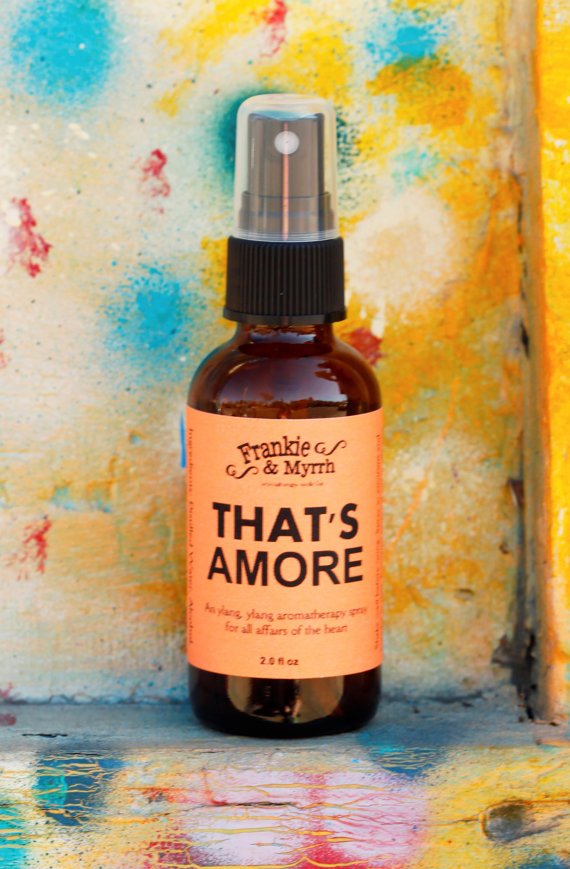
That's Amore --- Aromatherapy For The Impasssioned --- An Ylang Ylang Spray/Perfume/Cologne -
More than 10 available
Details
Shipping: Australia: free (more destinations)
Sales Tax: check
Condition: Brand new
*The store has not been updated recently. You may want to contact the merchant to confirm the availability of the product.
That's Amore --- An Ylang Ylang Spray/Perfume/Cologne --- Aromatherapy for the Impassioned!
Ylang Ylang is a long-used aphrodisiac. It has an exotic, sweet, spicy, and flowery fragrance that has made it a romantic favorite. Ylang Ylang is a distinct ingredient in Chanel No. 5 and ladies have been using Chanel No. 5 for a long, long time to seduce people, if you will. In Indonesia, the petals are often used in wedding ceremonies and other expressions of love or romance.
We added Lavender to give the scent a light floral start. Jasmine briefly starts the middle, then the warming, spicy, flower power of Ylang Ylang holds in your nose. A little Vanilla sweetens near the end and a hint of Patchouli finishes.
A great light cologne/perfume with a purpose.. Spray on pillows and bedding before lovemaking. May be used as an after-shower body mist or as a deodorant spray under clothing. Works great as a car freshener, room freshener, or linen spray. Carry in your purse as a hand sanitizer.
Be sure to breathe in aroma. Spray into air, walk into spray and inhale. Repeat for more scent and aromatherapy effect. For best aromatherapy results:-- Spray several times into cupped hands, place hands over nose and mouth----then inhale deeply for 30 seconds. Avoid getting product in eyes.
Ingredients: Distilled Water, Alcohol, Essential Oils of Ylang Ylang, Lavender, Vanilla, Jasmine, and Patchouli, and Fractionated Coconut Oil.
**Please consult your doctor before use, if you are pregnant or have any medical condition. Avoid getting product in eyes. This product has not been evaluated by the FDA and is not intended to diagnose, cure, treat, or prevent disease. Individual results may vary.
Ylang Ylang Info FYI:
''It is a highly valued essence both in perfumery for the power of its delicate flowery note, and in aromatherapy for its action on the nervous system in all symptoms derived from stress, such as hypertension, tachycardia and sleeplessness. From time immemorial the natives of the islands have used the flowers of ylang ylang to treat their hair. In fact, this flower is the main ingredient of the famed Macassar oil. Ylang ylang essence has an hormonal effect and is used in aromatherapy for the cure of many feminine problems.''
The original home of Cananga is probably South East Asia. However, it is now naturalized in Burma, Malaysia, Indonesia, Papua New Guinea and Pacific Islands and Philipines. It has been introduced into tropical countries in Africa, Asia, the Caribbean and the Americas, specifically as an essential oil plant. The tree requires moist tropical climate, grows well in rich volcanic soils or fertile sandy loams. It grows both in vine and tree form. Vine bears flowers early and more blooms with fragrance in the evening when flowers get yellow. But both are slow growers. It also thrives well in my coastal city Karchi.
Genus Cananga has two species; C. odorata, the source of cananga and ylang-ylang oil and C. lotifolia, which produces an oil of commercial importance. Leaves are described as numerous, thin, alternate with a sharply pointed apex and a base rounded on light green petioles. Flowers are numerous, large, yellow-green, strongly scented and borne on slender,light green stalks in axillary clusters, and have six petals with slightly recurved tips. The flowers start to droop when mature.
Propagation is largley by seeds and usually takes place spontaneously by means of fruits (seeds) falling of the trees or by birds eating the fruit and dropping it elsewehere. The flowering of the plant also depeneds on the altitudes, as at low altitudes trees require only a few years to give an economic flower harvest, whereas, at higher and cooler altitudes (500 m above sea level) they grow much more slowly and require seven to ten years to poduce flowers in quantities sufficient for harvesting. Periodic pruning of the tree has to be undertaken to prevent growth of the tree beyond 2-3 m height. Trees of more than 20 years old reach a height of about 30m.
The tree flowers troughout year however, the main flowering seasons are immediately after rain and during the dry season.
Talking of harvesting, the question is when to harvest flowers? Initially, flowers have little fragrance when the petals are still green and are covered with fine white hairs (which disappear with maturity). After 14-21 days, the petals become pale green, then yellow and their scent becomes progressively stronger. When a small reddish tint appears on the base of the petals, the flowers are ready for picking. The harvesting should be done during early morning hours as the flowers contain more essential oil during night, particularly just before daybreak, and as the day progresses, especially in strong sunlight, the oil content rapidly diminishes.
Steam distillation is a preferred method for the extraction of oil. We will particularly talk about C.odorata as this is the source of cananga and ylang-ylang oil. The main use of cananga oil is in soaps, toiletries and less expensive perfumeries. Whereas, ylang-ylang oil is highly appreciated in perfumery because of its delightfuly sweet, heavenly and strong odor. Ylang-ylang oil is normally available in four grades, namely, extra, first, second and third. Extra grade oil is extensively used in high quality fragrances.
When Perfumer Anya McCoy spotted Ylang-Ylang flowers blooming in her garden she shared about it on her blog, and I loved the last part so much that I asked for her permission to share it with you all. She says:
''If you live in the tropics, I urge you to grow it. The flowers have a delicate sweetness that is not present in even the best distillation, the extra grade, nor is it in ylang concrete or absolute, created with solvents. My garden is perfume heaven right now, and if you can grow this, and keep it pruned to a reasonable size, you will have a perfume heaven in your garden, also.''
Ylang Ylang is a long-used aphrodisiac. It has an exotic, sweet, spicy, and flowery fragrance that has made it a romantic favorite. Ylang Ylang is a distinct ingredient in Chanel No. 5 and ladies have been using Chanel No. 5 for a long, long time to seduce people, if you will. In Indonesia, the petals are often used in wedding ceremonies and other expressions of love or romance.
We added Lavender to give the scent a light floral start. Jasmine briefly starts the middle, then the warming, spicy, flower power of Ylang Ylang holds in your nose. A little Vanilla sweetens near the end and a hint of Patchouli finishes.
A great light cologne/perfume with a purpose.. Spray on pillows and bedding before lovemaking. May be used as an after-shower body mist or as a deodorant spray under clothing. Works great as a car freshener, room freshener, or linen spray. Carry in your purse as a hand sanitizer.
Be sure to breathe in aroma. Spray into air, walk into spray and inhale. Repeat for more scent and aromatherapy effect. For best aromatherapy results:-- Spray several times into cupped hands, place hands over nose and mouth----then inhale deeply for 30 seconds. Avoid getting product in eyes.
Ingredients: Distilled Water, Alcohol, Essential Oils of Ylang Ylang, Lavender, Vanilla, Jasmine, and Patchouli, and Fractionated Coconut Oil.
**Please consult your doctor before use, if you are pregnant or have any medical condition. Avoid getting product in eyes. This product has not been evaluated by the FDA and is not intended to diagnose, cure, treat, or prevent disease. Individual results may vary.
Ylang Ylang Info FYI:
''It is a highly valued essence both in perfumery for the power of its delicate flowery note, and in aromatherapy for its action on the nervous system in all symptoms derived from stress, such as hypertension, tachycardia and sleeplessness. From time immemorial the natives of the islands have used the flowers of ylang ylang to treat their hair. In fact, this flower is the main ingredient of the famed Macassar oil. Ylang ylang essence has an hormonal effect and is used in aromatherapy for the cure of many feminine problems.''
The original home of Cananga is probably South East Asia. However, it is now naturalized in Burma, Malaysia, Indonesia, Papua New Guinea and Pacific Islands and Philipines. It has been introduced into tropical countries in Africa, Asia, the Caribbean and the Americas, specifically as an essential oil plant. The tree requires moist tropical climate, grows well in rich volcanic soils or fertile sandy loams. It grows both in vine and tree form. Vine bears flowers early and more blooms with fragrance in the evening when flowers get yellow. But both are slow growers. It also thrives well in my coastal city Karchi.
Genus Cananga has two species; C. odorata, the source of cananga and ylang-ylang oil and C. lotifolia, which produces an oil of commercial importance. Leaves are described as numerous, thin, alternate with a sharply pointed apex and a base rounded on light green petioles. Flowers are numerous, large, yellow-green, strongly scented and borne on slender,light green stalks in axillary clusters, and have six petals with slightly recurved tips. The flowers start to droop when mature.
Propagation is largley by seeds and usually takes place spontaneously by means of fruits (seeds) falling of the trees or by birds eating the fruit and dropping it elsewehere. The flowering of the plant also depeneds on the altitudes, as at low altitudes trees require only a few years to give an economic flower harvest, whereas, at higher and cooler altitudes (500 m above sea level) they grow much more slowly and require seven to ten years to poduce flowers in quantities sufficient for harvesting. Periodic pruning of the tree has to be undertaken to prevent growth of the tree beyond 2-3 m height. Trees of more than 20 years old reach a height of about 30m.
The tree flowers troughout year however, the main flowering seasons are immediately after rain and during the dry season.
Talking of harvesting, the question is when to harvest flowers? Initially, flowers have little fragrance when the petals are still green and are covered with fine white hairs (which disappear with maturity). After 14-21 days, the petals become pale green, then yellow and their scent becomes progressively stronger. When a small reddish tint appears on the base of the petals, the flowers are ready for picking. The harvesting should be done during early morning hours as the flowers contain more essential oil during night, particularly just before daybreak, and as the day progresses, especially in strong sunlight, the oil content rapidly diminishes.
Steam distillation is a preferred method for the extraction of oil. We will particularly talk about C.odorata as this is the source of cananga and ylang-ylang oil. The main use of cananga oil is in soaps, toiletries and less expensive perfumeries. Whereas, ylang-ylang oil is highly appreciated in perfumery because of its delightfuly sweet, heavenly and strong odor. Ylang-ylang oil is normally available in four grades, namely, extra, first, second and third. Extra grade oil is extensively used in high quality fragrances.
When Perfumer Anya McCoy spotted Ylang-Ylang flowers blooming in her garden she shared about it on her blog, and I loved the last part so much that I asked for her permission to share it with you all. She says:
''If you live in the tropics, I urge you to grow it. The flowers have a delicate sweetness that is not present in even the best distillation, the extra grade, nor is it in ylang concrete or absolute, created with solvents. My garden is perfume heaven right now, and if you can grow this, and keep it pruned to a reasonable size, you will have a perfume heaven in your garden, also.''


