
$4.16
Add to Cart
1892 Victorian Trade Card - Arbuckle Brothers Coffee Company - MISSOURI (#34)
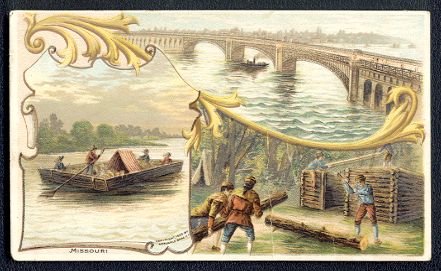


SERIES: Pictorial History of the United States and Territories
SCENES: The Eads Bridge at St. Louis; Founding St. Louis by Chateau, 1764; Old-Time Flat Boat going down the Mississippi.
SIZE: 3" x 5"
DATE: 1892
LITHOGRAPHER: Donaldson Brothers, N.Y.
CONDITION: Very good, I'd say. This card is only lightly soiled with slightly worn edges and corners. However, it does have a sharp vertical crease just to the right of center. (Please see scans.)
MULTIPLE ITEM SHIPPING DISCOUNT: I will ship up to 4 cards for the single base shipping charge shown. For purchases of more than 4 cards, the shipping charge will increase by just a small increment for every 4 additional cards.
--------------------------------------------------------------
REVERSE TEXT: MISSOURI
MISSOURI fell to the share of France, by virtue of the discoveries of Marquette and Joliet in 1673, and La Salle and Hennepin in 1682. A settlement arose at St. Genevieve about the year 1750. The site of St. Louis was selected by Pierre Lacléde Lijneste, who sent August Chateau to found a village there in 1776. Many French families exiled themselves from Illinois when that provice passed into English hands, and dwelt along the Missouri shore, trading in furs with the northwestern Indians, and farming along the rich bottom-lands. The Louisiana Purchase, made by the United States from Napoleon in 1803, included Missouri, which for a time lay in the district of Louisiana, afterwards the Territory of Louisiana. After the War of 1812, thousands of emigrants poured in from Kentucky, Tennessee and the Carolinas. The application of Missouri to be admitted into the Union in 1818 was followed by a long period of angry discussion, the Northern States being sternly opposed to the creation of another slave-holding commonwealth, while the Southern people maintained that since slavery had always existed in Missouri, under the French and Spanish Governments, it could not legally be abolished. Finally, the famous Missouri Compromise went into effect, bringing the new State into the Union with her existing social system, but excluding slavery from all the rest of the Louisiana Purchase north of 36° 30´.
SCENES: The Eads Bridge at St. Louis; Founding St. Louis by Chateau, 1764; Old-Time Flat Boat going down the Mississippi.
SIZE: 3" x 5"
DATE: 1892
LITHOGRAPHER: Donaldson Brothers, N.Y.
CONDITION: Very good, I'd say. This card is only lightly soiled with slightly worn edges and corners. However, it does have a sharp vertical crease just to the right of center. (Please see scans.)
MULTIPLE ITEM SHIPPING DISCOUNT: I will ship up to 4 cards for the single base shipping charge shown. For purchases of more than 4 cards, the shipping charge will increase by just a small increment for every 4 additional cards.
--------------------------------------------------------------
REVERSE TEXT: MISSOURI
MISSOURI fell to the share of France, by virtue of the discoveries of Marquette and Joliet in 1673, and La Salle and Hennepin in 1682. A settlement arose at St. Genevieve about the year 1750. The site of St. Louis was selected by Pierre Lacléde Lijneste, who sent August Chateau to found a village there in 1776. Many French families exiled themselves from Illinois when that provice passed into English hands, and dwelt along the Missouri shore, trading in furs with the northwestern Indians, and farming along the rich bottom-lands. The Louisiana Purchase, made by the United States from Napoleon in 1803, included Missouri, which for a time lay in the district of Louisiana, afterwards the Territory of Louisiana. After the War of 1812, thousands of emigrants poured in from Kentucky, Tennessee and the Carolinas. The application of Missouri to be admitted into the Union in 1818 was followed by a long period of angry discussion, the Northern States being sternly opposed to the creation of another slave-holding commonwealth, while the Southern people maintained that since slavery had always existed in Missouri, under the French and Spanish Governments, it could not legally be abolished. Finally, the famous Missouri Compromise went into effect, bringing the new State into the Union with her existing social system, but excluding slavery from all the rest of the Louisiana Purchase north of 36° 30´.


