
$41.39
On Hold
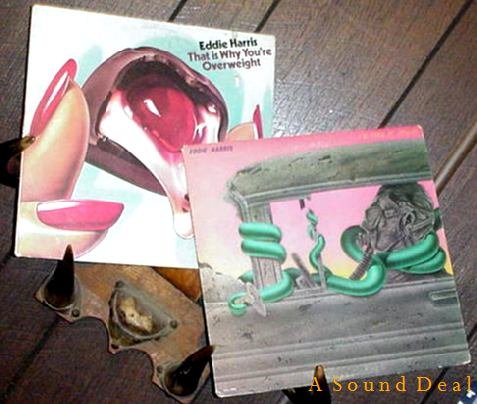
EDDIE HARRIS 2 LP LOT TIRED OF DRIVING + WHY OVERWEIGHT


Only 1 available
Details
Shipping: USPS calculated - check
Condition: Used
*The store has not been updated recently. You may want to contact the merchant to confirm the availability of the product.
EDDIE HARRIS 2 LP LOTCategory / Style / Moods: Jazz * Mainstream Jazz * Jazz-Funk * Soul-Jazz * Hard Bop * Fusion29.42 / 2008-01-31 S asoccFUNKY PAIR OF HARD TO FINDEDDIE HARRIS LPs1. 1976 RCA US LPTITLE: I'M TIRED OF DRIVINGARTIST: CONDITIONCOVER: VGVINYL: LOOKS AND PLAYS VERY NEAR VG+ TO VG+Click here for info on grading and abbreviationsOUT OF PRINT ORIGINAL PRESS WITH GOLD DJ PROMO STAMP ON BACK2. 1975 ATLANTIC US K 50259 LPTITLE: THAT IS WHY YOU'RE OVERWEIGHTARTIST: EDDIE HARRISCONDITIONCOVER: VG-VINYL: SOLID VGTOUGH TO FIND ORIGINAL PRESSClick the pix for a better view TRACKS: Disc: 1 1.Two Times Two Equals Love5:552.You Are the One3:573.Songbird4:054.I'm Tired of Driving4:505.Loneliest Monk3:586.Theme for the Foxy Ladies3:397.You Stole My HeartHarris 3:188.There Was a Time (Echo of Harlem)Harris 5:029.What's Wrong With the World Today4:35TRACKS: Disc: 1 1.It's All Right Now3:532.Why Do You Hurt Me4:153.Flowers5:014.That is Why You're Overweight7:225.Tryin' Ain't Dyin'7:096.Live Again4:177.Ooh2:488.Exempt7:37Label: Atlantic Catalog#: K 50259 Format: Vinyl, LP Country: US Released: 1975 Genre: Jazz, Funk / Soul Style: Hard Bop, Soul-Jazz, FunkBiography by Steve Huey Long underrated in the pantheon of jazz greats, Eddie Harris was an eclectic and imaginative saxophonist whose career was marked by a hearty appetite for experimentation. For quite some time, he was far more popular with audiences than with critics, many of whom denigrated him for his more commercially successful ventures. Harris' tastes ranged across the spectrum of black music, not all of which was deemed acceptable by jazz purists. He had the chops to handle technically demanding bop, and the restraint to play in the cool-toned West Coast style, but he also delved into crossover-friendly jazz-pop, rock- and funk-influenced fusion, outside improvisations, bizarre electronic effects, new crossbreedings of traditional instruments, blues crooning, and even comedy. Much of this fell outside the bounds of what critics considered legitimate, serious jazz, and so they dismissed him out of hand as too mainstream or too gimmicky. To be fair, Harris' large catalog is certainly uneven; not everything he tried worked. Yet with the passage of time, the excellence of his best work has become abundantly clear. Harris' accomplishments are many: he was the first jazz artist to release a gold-selling record, thanks to 1961's hit adaptation of the "Exodus" movie theme; he was universally acknowledged as the best player of the electric Varitone sax, as heard on his hit 1967 album The Electrifying Eddie Harris; he was an underrated composer whose "Freedom Jazz Dance" was turned into a standard by Miles Davis; he even invented his own instruments by switching brass and reed mouthpieces. Plus, his 1969 set with Les McCann at the Montreux Jazz Festival was released as Swiss Movement, and became one of the biggest-selling jazz albums of all time. Harris was born in Chicago on October 20, 1934. His first musical experiences were as a singer in church, starting at age five, and he soon began playing hymns by ear on the piano. He spent part of his high school years at Du Sable, where he studied the vibraphone under the legendary band director Walter Dyett, a disciplinarian who trained some of the South Side's greatest jazzmen: Nat King Cole, Johnny Griffin, Gene Ammons, Julian Priester, and many others (even rocker Bo Diddley). He later returned to the piano and took up the tenor sax as well, and went on to study music at Roosevelt College. He landed his first professional job as a pianist, backing saxman Gene Ammons, and got the chance to sit in with greats like Charlie Parker and Lester Young. After college, he was drafted into the military; while serving in Europe, he successfully auditioned for the 7th Army band, which also included the likes of Don Ellis, Leo Wright, and Cedar Walton, among others. Following his discharge, he lived in New York and played in whatever groups and venues he could, still chiefly as a pianist. Harris returned to Chicago in 1960 and soon signed with the successful, locally based Vee Jay, which was better known for its R&B and blues acts. Although the label signed Harris as a pianist, he played only tenor sax on his first album. That album, 1961's Exodus to Jazz, would become one of jazz's most surprising success stories. The key track was "Exodus," Harris' easygoing rearrangement of Ernest Gold's theme from the epic Biblical film of the same name. It was an unlikely source for a jazz tune, and an even unlikelier hit, but it managed to catch on with mainstream radio; released as a single in a shortened version, it even climbed into the lower reaches of the pop Top 40. Its success pushed the LP all the way to number two on the pop album charts, and Exodus to Jazz became the first jazz album ever certified gold. This exquisite piece of retro music history is a vinyl sound recording (not a CD). Please visit the A Sound Deal store for similar items and information on grading and shipping. Add me to your favorites for red hot sales bulletins and sneak previews of upcoming products. Combine Items to Save $$$! Click here to check the store for more!©A Sound Deal


