
$55.75
Add to Cart
Howlin' Wolf - The Howlin' Wolf Album 1969 GRT CADET T23 8-TRACK TAPE
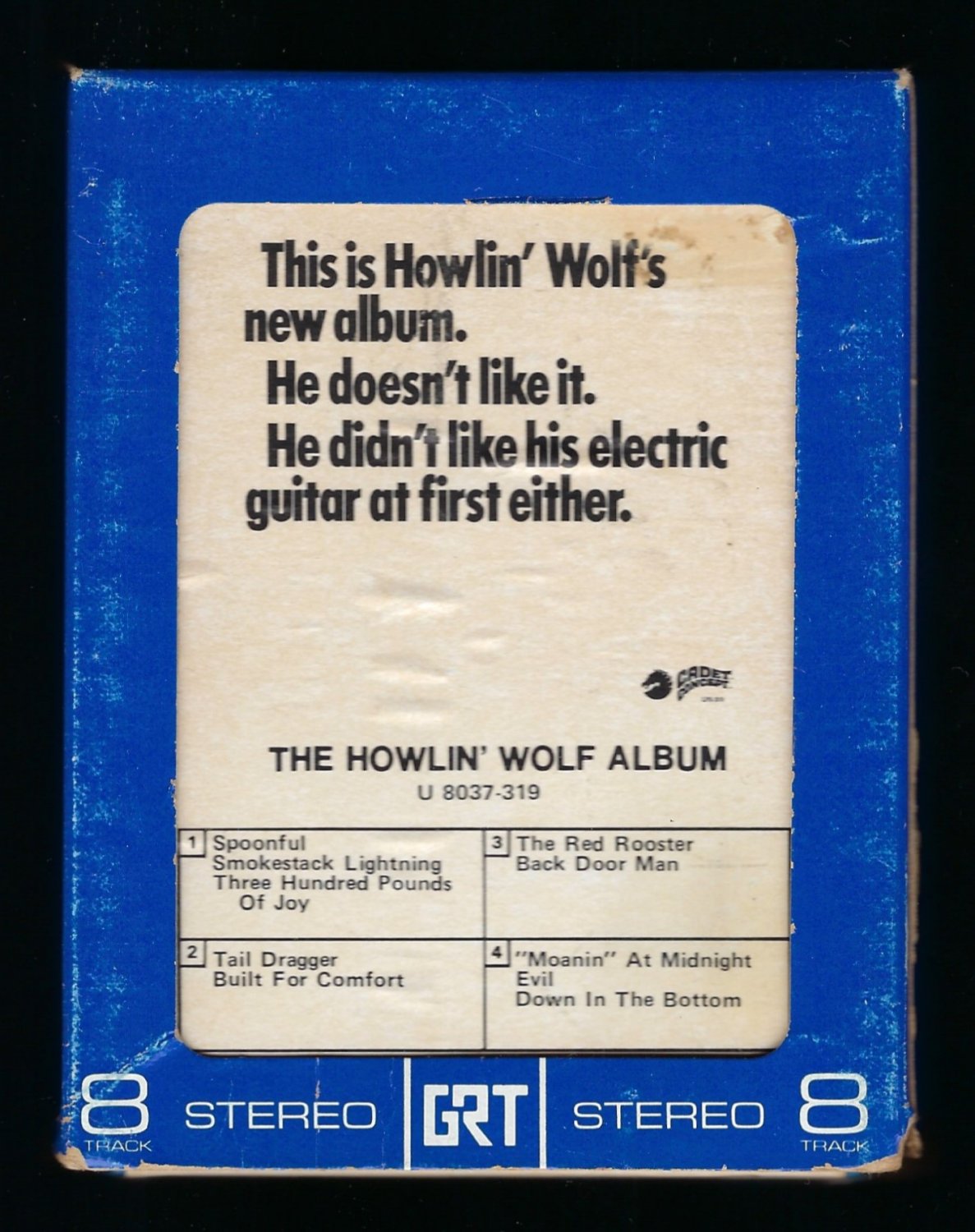


The Howlin' Wolf Album is a 1969 album by Howlin' Wolf which mixed blues with psychedelic rock arrangements on several of Howlin' Wolf's classic songs. Howlin' Wolf strongly disliked the album, and Chess Records referenced this fact on the album's cover. The album peaked at #69 on the Billboard Black Albums chart.
In 1968, Chess Records made an attempt to modernize the sound of bluesmen Howlin' Wolf and Muddy Waters by convincing them to record Jimi Hendrix-inspired psychedelic arrangements resulting in the albums Electric Mud and The Howlin' Wolf Album. The recording sessions for The Howlin' Wolf Album featured the same musicians as Electric Mud. Howlin' Wolf disliked the proposed sound, which he did not consider to be blues. According to guitarist Pete Cosey, during the recording sessions, Howlin' Wolf "looked at me and he said 'Why don't you take them wah-wahs and all that other shit and go throw it off in the lake — on your way to the barber shop?'"
Marshall Chess referred to Howlin' Wolf's dislike of the arrangements on the album's cover. Howlin' Wolf took exception to the blurb, as he had enthusiastically adopted the use of electric guitar, and had led the first entirely electric blues combo in West Memphis in the early 1950s. Howlin' Wolf stated that the album was "dog shit". According to Chess, the album's cover hurt its sales. Chess states that "I used negativity in the title, and it was a big lesson: You can't say on the cover that the artist didn't like the album. It didn't really sell that well. But it was just an attempt. They were just experiments."
The Howlin' Wolf Album did not sell as well as Electric Mud. The Howlin' Wolf Album peaked at #69 on the Billboard Black Albums chart. The album's single, "Evil", peaked at #43 on the R&B Singles chart.
On March 22, 2011, a digitally remastered edition was released on compact disc by Get On Down Records. However, "Back Door Man" was about 33 seconds shorter on the compact disc reissue, appearing at 6:17, rather than 6:51 on the vinyl edition.
Chester Arthur Burnett (June 10, 1910 – January 10, 1976), known as Howlin' Wolf, was an influential American blues singer, guitarist and harmonica player. He was born in West Point, Mississippi in an area now known as White Station.
With a booming voice and looming physical presence, Burnett is commonly ranked among the leading performers in electric blues; musician and critic Cub Koda declared, "no one could match Howlin' Wolf for the singular ability to rock the house down to the foundation while simultaneously scaring its patrons out of its wits." A number of songs written or popularized by Burnett—such as "Smokestack Lightnin'", "Back Door Man", "Killing Floor" and "Spoonful"—have become blues and blues rock standards.
At 6 feet, 6 inches (197 cm) and close to 300 pounds (136 kg), he was an imposing presence with one of the loudest and most memorable voices of all the "classic" 1950s Chicago blues singers. This rough-edged, slightly fearsome musical style is often contrasted with the less crude but still powerful presentation of his contemporary and professional rival, Muddy Waters. Howlin' Wolf, Sonny Boy Williamson (Rice Miller), Little Walter Jacobs, and Muddy Waters are usually regarded in retrospect as the greatest blues artists who recorded for Chess in Chicago. Sam Phillips once remarked, "When I heard Howlin' Wolf, I said, 'This is for me. This is where the soul of man never dies.'" In 2004, Rolling Stone magazine ranked him #51 on their list of the "100 Greatest Artists of All Time".
Retrieved from
http://en.wikipedia.org/wiki/Howlin%27_Wolf
T23
Comes to you fully restored with a new foil splice, foam pad and a 7-day money back guarantee.
In 1968, Chess Records made an attempt to modernize the sound of bluesmen Howlin' Wolf and Muddy Waters by convincing them to record Jimi Hendrix-inspired psychedelic arrangements resulting in the albums Electric Mud and The Howlin' Wolf Album. The recording sessions for The Howlin' Wolf Album featured the same musicians as Electric Mud. Howlin' Wolf disliked the proposed sound, which he did not consider to be blues. According to guitarist Pete Cosey, during the recording sessions, Howlin' Wolf "looked at me and he said 'Why don't you take them wah-wahs and all that other shit and go throw it off in the lake — on your way to the barber shop?'"
Marshall Chess referred to Howlin' Wolf's dislike of the arrangements on the album's cover. Howlin' Wolf took exception to the blurb, as he had enthusiastically adopted the use of electric guitar, and had led the first entirely electric blues combo in West Memphis in the early 1950s. Howlin' Wolf stated that the album was "dog shit". According to Chess, the album's cover hurt its sales. Chess states that "I used negativity in the title, and it was a big lesson: You can't say on the cover that the artist didn't like the album. It didn't really sell that well. But it was just an attempt. They were just experiments."
The Howlin' Wolf Album did not sell as well as Electric Mud. The Howlin' Wolf Album peaked at #69 on the Billboard Black Albums chart. The album's single, "Evil", peaked at #43 on the R&B Singles chart.
On March 22, 2011, a digitally remastered edition was released on compact disc by Get On Down Records. However, "Back Door Man" was about 33 seconds shorter on the compact disc reissue, appearing at 6:17, rather than 6:51 on the vinyl edition.
Chester Arthur Burnett (June 10, 1910 – January 10, 1976), known as Howlin' Wolf, was an influential American blues singer, guitarist and harmonica player. He was born in West Point, Mississippi in an area now known as White Station.
With a booming voice and looming physical presence, Burnett is commonly ranked among the leading performers in electric blues; musician and critic Cub Koda declared, "no one could match Howlin' Wolf for the singular ability to rock the house down to the foundation while simultaneously scaring its patrons out of its wits." A number of songs written or popularized by Burnett—such as "Smokestack Lightnin'", "Back Door Man", "Killing Floor" and "Spoonful"—have become blues and blues rock standards.
At 6 feet, 6 inches (197 cm) and close to 300 pounds (136 kg), he was an imposing presence with one of the loudest and most memorable voices of all the "classic" 1950s Chicago blues singers. This rough-edged, slightly fearsome musical style is often contrasted with the less crude but still powerful presentation of his contemporary and professional rival, Muddy Waters. Howlin' Wolf, Sonny Boy Williamson (Rice Miller), Little Walter Jacobs, and Muddy Waters are usually regarded in retrospect as the greatest blues artists who recorded for Chess in Chicago. Sam Phillips once remarked, "When I heard Howlin' Wolf, I said, 'This is for me. This is where the soul of man never dies.'" In 2004, Rolling Stone magazine ranked him #51 on their list of the "100 Greatest Artists of All Time".
Retrieved from
http://en.wikipedia.org/wiki/Howlin%27_Wolf
T23
Comes to you fully restored with a new foil splice, foam pad and a 7-day money back guarantee.


