
$214.95
Add to Cart
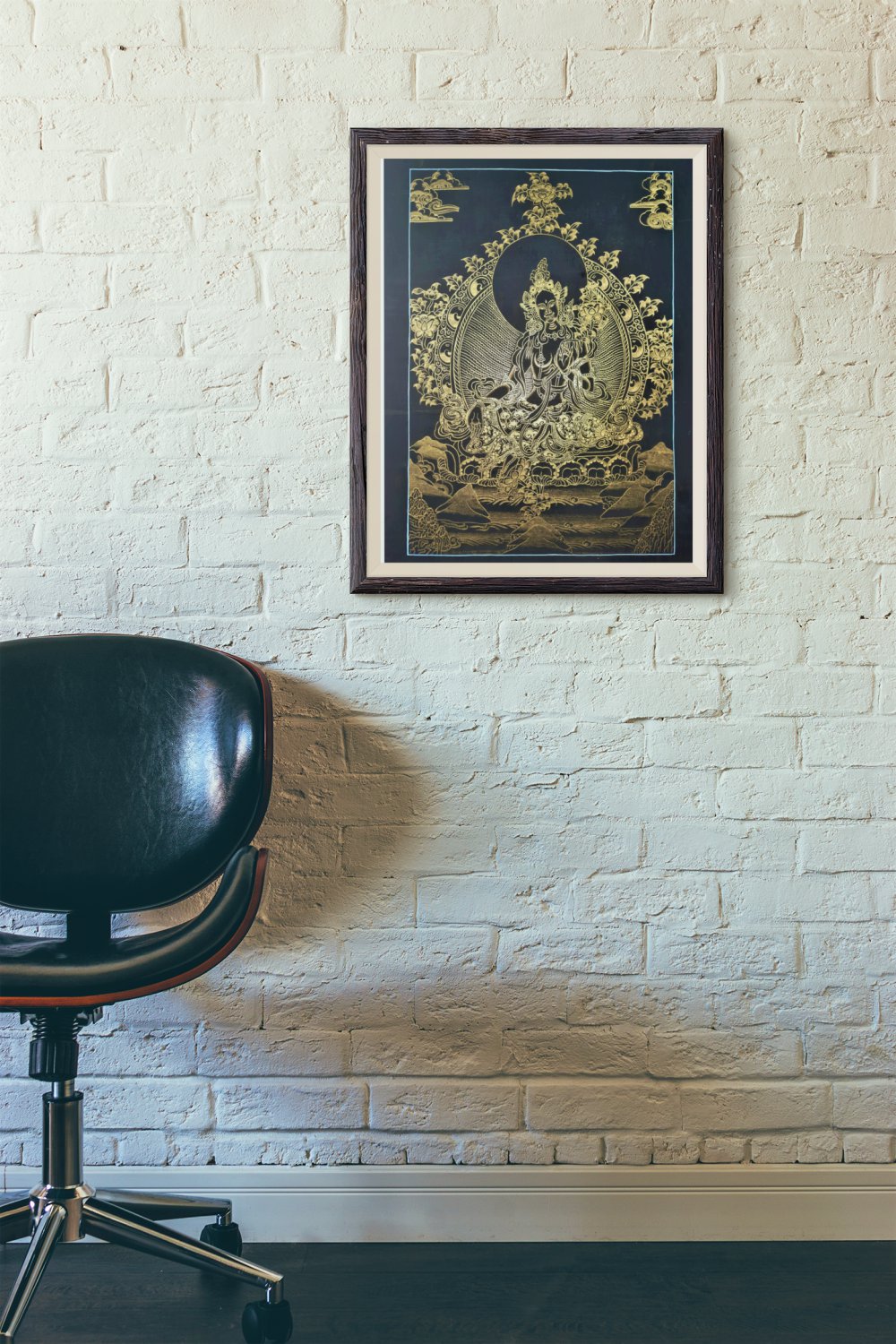
Green Tara Hand Painted Canvas Cotton Tibetan Thangka Painting From Nepal
Only 1 available
Details
Shipping: Australia: free (more destinations)
Condition: Brand new
Returns: 14 days, seller pays return shipping (more)


Tibetan Thangka painting depicting Green Tara Large Size is perfect for various home décor ideas! This 100% hand-drawn Thangka painting made in Kathmandu Valley, Nepal can be decorated as an elegant and eccentric wall hanging in your home or office being a centrepiece of attention. It can also be placed on your family altar for meditation purposes as well as spiritual and emotional healing, attracting benevolent energy of the Tibetan Buddhist art.
Specification
Master Quality Tibetan Thangka Painting
Dimensions: 43 x 33 cm
Materials: Tibetan Black And Gold Dust With Tibetan Hide Glue
Canvas: Tibetan Organic Cotton
Origin: Hand Painted In Nepal
About Green Tara Thangka Art
Green Tara is a female Buddha and one of the most well-known goddesses in the Buddhist world. You can find her image in many feng shui adornments, from embroideries to colorful sculptures. Tara has many forms and appears in various colors—with each hue representing a different aspect of her energy.
The Green Tara (Sanskrit: Shyamatara; Tibetan: Sgrol-ljang) was believed to be incarnated as the Nepali princess. She is considered by some to be the original Tara and is the female consort of Amoghasiddhi (see Dhyani-Buddha), one of the “self-born” buddhas. She is generally shown seated on a lotus throne with right leg hanging down, wearing the ornaments of a bodhisattva and holding the closed blue lotus (utpala).
The White and Green Taras, with their contrasting symbols of the full-blown and closed lotus, are said to symbolize between them the unending compassion of the deity who labours both day and night to relieve suffering. Under the influence of Tibetan Buddhism the different forms of Tara multiplied to a traditional 108. Tibetan temple banners frequently show 21 different Taras, coloured white, red, and yellow, grouped around a central Green Tara. The figure of the “self-born” Amitabha Buddha is often shown in her headdress, as she, like Avalokiteshvara, is considered to be an emanation of Amitabha.
What Is A Thangka Painting?
A thangka, variously spelt as thangka, tangka, thanka, or tanka, is a Tibetan Buddhist painting on cotton, silk appliqué, usually depicting a Buddhist deity, scene, or mandala. Thangkas are traditionally kept unframed and rolled up when not on display, mounted on a textile backing somewhat in the style of Chinese scroll paintings, with a further silk cover on the front. So treated, thangkas can last a long time, but because of their delicate nature, they have to be kept in dry places where moisture will not affect the quality of the silk. Most thangkas are relatively small, comparable in size to a Western half-length portrait, but some are extremely large, several metres in each dimension; these were designed to be displayed, typically for very brief periods on a monastery wall, as part of religious festivals. Most thangkas were intended for personal meditation or instruction of monastic students. They often have elaborate compositions including many very small figures. A central deity is often surrounded by other identified figures in a symmetrical composition. Narrative scenes are less common, but do appear.
Specification
Master Quality Tibetan Thangka Painting
Dimensions: 43 x 33 cm
Materials: Tibetan Black And Gold Dust With Tibetan Hide Glue
Canvas: Tibetan Organic Cotton
Origin: Hand Painted In Nepal
About Green Tara Thangka Art
Green Tara is a female Buddha and one of the most well-known goddesses in the Buddhist world. You can find her image in many feng shui adornments, from embroideries to colorful sculptures. Tara has many forms and appears in various colors—with each hue representing a different aspect of her energy.
The Green Tara (Sanskrit: Shyamatara; Tibetan: Sgrol-ljang) was believed to be incarnated as the Nepali princess. She is considered by some to be the original Tara and is the female consort of Amoghasiddhi (see Dhyani-Buddha), one of the “self-born” buddhas. She is generally shown seated on a lotus throne with right leg hanging down, wearing the ornaments of a bodhisattva and holding the closed blue lotus (utpala).
The White and Green Taras, with their contrasting symbols of the full-blown and closed lotus, are said to symbolize between them the unending compassion of the deity who labours both day and night to relieve suffering. Under the influence of Tibetan Buddhism the different forms of Tara multiplied to a traditional 108. Tibetan temple banners frequently show 21 different Taras, coloured white, red, and yellow, grouped around a central Green Tara. The figure of the “self-born” Amitabha Buddha is often shown in her headdress, as she, like Avalokiteshvara, is considered to be an emanation of Amitabha.
What Is A Thangka Painting?
A thangka, variously spelt as thangka, tangka, thanka, or tanka, is a Tibetan Buddhist painting on cotton, silk appliqué, usually depicting a Buddhist deity, scene, or mandala. Thangkas are traditionally kept unframed and rolled up when not on display, mounted on a textile backing somewhat in the style of Chinese scroll paintings, with a further silk cover on the front. So treated, thangkas can last a long time, but because of their delicate nature, they have to be kept in dry places where moisture will not affect the quality of the silk. Most thangkas are relatively small, comparable in size to a Western half-length portrait, but some are extremely large, several metres in each dimension; these were designed to be displayed, typically for very brief periods on a monastery wall, as part of religious festivals. Most thangkas were intended for personal meditation or instruction of monastic students. They often have elaborate compositions including many very small figures. A central deity is often surrounded by other identified figures in a symmetrical composition. Narrative scenes are less common, but do appear.


 GB, Middlesex
