
$2.51
Add to Cart
ALASKA Marigolds ,Tagetes ,organic seeds, 0,5g, ##81
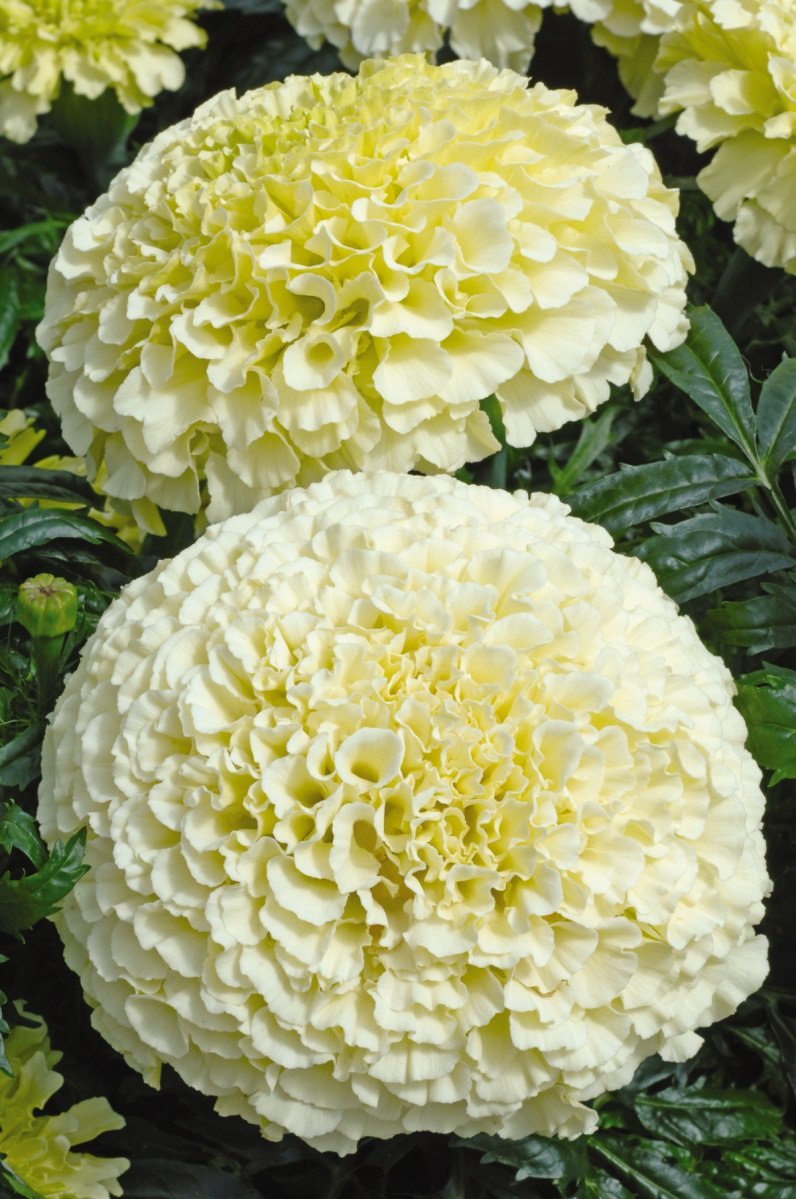
Tagetes is a genus of annual or perennial, mostly herbaceous plants in the sunflower family (Asteraceae). It was described as a genus by Carl Linnaeus in 1753.
The plants are native to the Americas, growing naturally from the southwestern United States into South America, but some species have become naturalized around the world.
Description
Tagetes species vary in size from 0.1 to 2.2 m tall. Most species have pinnate green leaves. Blooms naturally occur in golden, orange, yellow, and white colors, often with maroon highlights. Floral heads are typically (1-) to 4–6 cm diameter, generally with both ray florets and disc florets. In horticulture, they tend to be planted as annuals, although the perennial species are gaining popularity. They have fibrous roots.
Depending on the species, Tagetes species grow well in almost any sort of soil. Most horticultural selections grow best in soil with good drainage, even though some cultivars are known to have good tolerance to drought.
Nomenclature
The most commonly cultivated varieties of Tagetes are known variously as African marigolds (usually referring to cultivars and hybrids of Tagetes erecta), or French marigolds (usually referring to hybrids and cultivars of Tagetes patula, many of which were developed in France). The so-called signet marigolds are hybrids derived mostly from Tagetes tenuifolia.
Cultivation and uses
Tagetes patula flowers
Depending on the species, marigold foliage has a musky, pungent scent, though some varieties have been bred to be scentless.
It is said to deter some common insect pests, as well as nematodes. Tagetes species are hence often used in companion planting for tomato, eggplant, chili pepper, tobacco, and potato. Due to antibacterial thiophenes exuded by the roots, Tagetes should not be planted near any legume crop. Some of the perennial species are deer-, rabbit-, rodent- and javalina or peccary-resistant.
T. minuta (khakibush or huacatay), originally from South America, has been used as a source of essential oil for the perfume and industry known as tagette or "marigold oil", and as a flavourant in the food and tobacco industries. It is commonly cultivated in South Africa, where the species is also a useful pioneer plant in the reclamation of disturbed land.
Other
Some species of Tagetes possess a characteristic scent, which repels insects such as mosquitoes, small animals and smaller, burrowing insects. Tagetes tenuifolia is one of these and is often planted near small creeks or puddle prone areas to repel bugs, especially mosquitoes. It was also found that the Tagetes tenuifolia contains thiophene which is a biocidal compound that acts as a natural pesticide to control nematodes in the field.
Traditional Medicine
Traditionally, the plants were decocted and used as a treatment for snakebites in Mexico, and the leafs were used as medicine for bruises in Peru. Tagetes tenuifolia could also be used as treatments for stomach flu in terms of indigestion, constipation, infant diarrhea.
The plants are native to the Americas, growing naturally from the southwestern United States into South America, but some species have become naturalized around the world.
Description
Tagetes species vary in size from 0.1 to 2.2 m tall. Most species have pinnate green leaves. Blooms naturally occur in golden, orange, yellow, and white colors, often with maroon highlights. Floral heads are typically (1-) to 4–6 cm diameter, generally with both ray florets and disc florets. In horticulture, they tend to be planted as annuals, although the perennial species are gaining popularity. They have fibrous roots.
Depending on the species, Tagetes species grow well in almost any sort of soil. Most horticultural selections grow best in soil with good drainage, even though some cultivars are known to have good tolerance to drought.
Nomenclature
The most commonly cultivated varieties of Tagetes are known variously as African marigolds (usually referring to cultivars and hybrids of Tagetes erecta), or French marigolds (usually referring to hybrids and cultivars of Tagetes patula, many of which were developed in France). The so-called signet marigolds are hybrids derived mostly from Tagetes tenuifolia.
Cultivation and uses
Tagetes patula flowers
Depending on the species, marigold foliage has a musky, pungent scent, though some varieties have been bred to be scentless.
It is said to deter some common insect pests, as well as nematodes. Tagetes species are hence often used in companion planting for tomato, eggplant, chili pepper, tobacco, and potato. Due to antibacterial thiophenes exuded by the roots, Tagetes should not be planted near any legume crop. Some of the perennial species are deer-, rabbit-, rodent- and javalina or peccary-resistant.
T. minuta (khakibush or huacatay), originally from South America, has been used as a source of essential oil for the perfume and industry known as tagette or "marigold oil", and as a flavourant in the food and tobacco industries. It is commonly cultivated in South Africa, where the species is also a useful pioneer plant in the reclamation of disturbed land.
Other
Some species of Tagetes possess a characteristic scent, which repels insects such as mosquitoes, small animals and smaller, burrowing insects. Tagetes tenuifolia is one of these and is often planted near small creeks or puddle prone areas to repel bugs, especially mosquitoes. It was also found that the Tagetes tenuifolia contains thiophene which is a biocidal compound that acts as a natural pesticide to control nematodes in the field.
Traditional Medicine
Traditionally, the plants were decocted and used as a treatment for snakebites in Mexico, and the leafs were used as medicine for bruises in Peru. Tagetes tenuifolia could also be used as treatments for stomach flu in terms of indigestion, constipation, infant diarrhea.


 UA, Odesa obl.
