
$14.50
On Hold
Neysastore US- 100 Pcs Mixed Colors Phalaenopsis Seeds Bonsai Balcony Flower Orchid Seeds
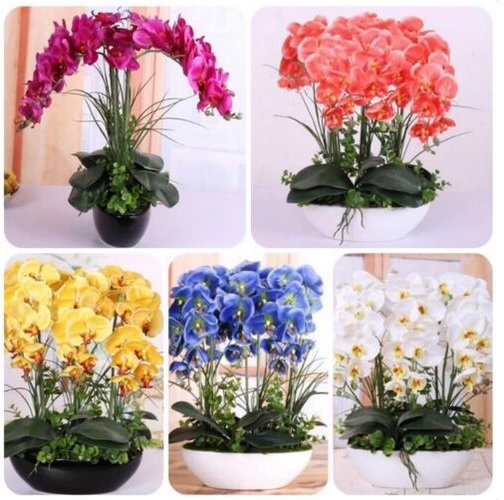
More than 10 available
Details
Shipping: Australia: $14.00 (more destinations)
Condition: Brand new
Returns: 7 days, seller pays return shipping (more)
Growing Phalaenopsis :
Phalaenopsis are fast becoming recognised as the most beautiful flowers in horticulture. The plants are also one of the fastest growers in the orchid family. Their long arching sprays of long lasting blooms are very popular both on the showbench and for floral arrangements and bridal bouquets. The plants and blooms may be a little more expensive than others because commercial production on a large scale usually entails heating in Winter and fan forced ventilation. Breeders are now producing a wider range of colours. Whites are still the most popular with showbench blooms reaching over 5 inches in diameter.
Mature plants can bloom from mid winter through to December if the spike is cut just above the third then the second live node from the bottom of the flower stem to produce a second and third flowering.
Warning: If the leaves go limp, cut off all blooms and spikes at the base immediately!
Although species Phalaenopsis mostly come from warm humid areas of the Philippines and surrounding islands, one is native to Australia, and others come from New Guinea and South East Asia.
Like most orchids they can be grown under a wide variety of situations if a few special conditions are met. It is therefore important (as with all orchids) to ask your nurseryman for relative cultural advice.
Phalaenopsis grow well under approximately the same conditions as African violets. So if you can grow African violets, you can grow Phalaenopsis.
Cultural Requirements :
Temperature Range :
Minimum of 15°C at night up to 30oC in daytime, except in Autumn (February, March and April) when they should be allowed to drop to 12oC at night for a few weeks to help initiate flower spikes.
After this, care should be taken to ensure a minimum nighttime temperature of 15°C for the rest of Winter. Although they are warm growers, above 30°C, they tend to stop growing, so if this is likely take steps to reduce the temperature by improving ventilation or misting the floor, etc.
Light :
In nature Phalaenopsis come from very shady locations in rainforest, so about 80% to 90% of shade is ideal (i.e. about 10% to 20% filtered direct sunlight). The extra light (20%) is given at spiking time in Autumn.
N.B.: This is filtered direct sunlight and NOT incident light coming from a side window. When the shadow of your hand is barely discernible, that is 10% sunlight. Generally, if leaves are a very dark green, that denotes too much shade (be sure excessive nitrogen in fertiliser is not the cause). If leaves are yellowish green, that denotes too much sun. Leaves should be firm and mid-green colour.
Watering :
These plants should NEVER dry right out, (unlike many other orchids) but should not be kept too wet either. Best to pot water if you can. If you must water overhead, tilt plants on an angle so that water does not lie in the crown. Water before 10 a.m., but only on fine, sunny days. Then let the leaves dry out for night. Remember cooler air at night deposits water on plants as it can't hold as much moisture as warm air. On a cold Winter morning, if you don't like a bucket of cold water thrown over you, don't do it to your plants: Wait till the water warms up to room temperature. Cold water on a spiking plant will drop buds.
Phalaenopsis are fast becoming recognised as the most beautiful flowers in horticulture. The plants are also one of the fastest growers in the orchid family. Their long arching sprays of long lasting blooms are very popular both on the showbench and for floral arrangements and bridal bouquets. The plants and blooms may be a little more expensive than others because commercial production on a large scale usually entails heating in Winter and fan forced ventilation. Breeders are now producing a wider range of colours. Whites are still the most popular with showbench blooms reaching over 5 inches in diameter.
Mature plants can bloom from mid winter through to December if the spike is cut just above the third then the second live node from the bottom of the flower stem to produce a second and third flowering.
Warning: If the leaves go limp, cut off all blooms and spikes at the base immediately!
Although species Phalaenopsis mostly come from warm humid areas of the Philippines and surrounding islands, one is native to Australia, and others come from New Guinea and South East Asia.
Like most orchids they can be grown under a wide variety of situations if a few special conditions are met. It is therefore important (as with all orchids) to ask your nurseryman for relative cultural advice.
Phalaenopsis grow well under approximately the same conditions as African violets. So if you can grow African violets, you can grow Phalaenopsis.
Cultural Requirements :
Temperature Range :
Minimum of 15°C at night up to 30oC in daytime, except in Autumn (February, March and April) when they should be allowed to drop to 12oC at night for a few weeks to help initiate flower spikes.
After this, care should be taken to ensure a minimum nighttime temperature of 15°C for the rest of Winter. Although they are warm growers, above 30°C, they tend to stop growing, so if this is likely take steps to reduce the temperature by improving ventilation or misting the floor, etc.
Light :
In nature Phalaenopsis come from very shady locations in rainforest, so about 80% to 90% of shade is ideal (i.e. about 10% to 20% filtered direct sunlight). The extra light (20%) is given at spiking time in Autumn.
N.B.: This is filtered direct sunlight and NOT incident light coming from a side window. When the shadow of your hand is barely discernible, that is 10% sunlight. Generally, if leaves are a very dark green, that denotes too much shade (be sure excessive nitrogen in fertiliser is not the cause). If leaves are yellowish green, that denotes too much sun. Leaves should be firm and mid-green colour.
Watering :
These plants should NEVER dry right out, (unlike many other orchids) but should not be kept too wet either. Best to pot water if you can. If you must water overhead, tilt plants on an angle so that water does not lie in the crown. Water before 10 a.m., but only on fine, sunny days. Then let the leaves dry out for night. Remember cooler air at night deposits water on plants as it can't hold as much moisture as warm air. On a cold Winter morning, if you don't like a bucket of cold water thrown over you, don't do it to your plants: Wait till the water warms up to room temperature. Cold water on a spiking plant will drop buds.


 ID, Jawa Timur
