
$2.77
Add to Cart
The Dance by Anna Pavlova, Daniel Gregory Mason, and Ivan Narodny
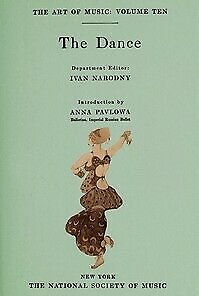


Only 1 available
Details
Shipping: Australia: free (more destinations)
Condition: Used
Returns: does not accept (more)
The Dance by Anna Pavlova, Daniel Gregory Mason, and Ivan Narodny - Digital BookINTRODUCTION‘The gods themselves danced, as the stars dance in the sky,’ is a saying of the ancient Mexicans. ‘To dance is to take part in the cosmic control of the world,’ said the ancient Greek philosophers. ‘What do you dance?’ asks the African Bantu of a member of another tribe after his greeting. Livingston said that when an African wild man danced, that was his religion. It is said that the savages do not preach their religion but dance it. According to the Bible, the ancient Hebrews danced before their Ark of the Covenant. St. Basil describes the angels dancing in Heaven. According to Dante, dancing is the real occupation of the inmates of Heaven, Christ acting as the leader of a celestial ballet. ‘Dancing,’ said Lucian, ‘is as old as love.’ Dance had a sacred and mystic meaning to the early Christians upon whom the Bible had made a deep impression: ‘We have piped unto you and ye have not danced.’The service of the Greek Church—even to-day—is for the most part only a kind of sacred dance, accompanied by chants and singing. The priest, walking and gesturing with an incense-pan up and down before the numerous ikons, kneeling, bowing to the saints, performing queer cabalistic figures with his hands in the air, and following always a certain rhythm, is essentially a dancer. It is said that dancing of a similar kindviii was performed in the English cathedrals until the fourteenth century. In France the priests danced in the choir at the Easter Mass up to the seventh century. In Spain similar religious dancing took deepest root and flourished longest. In the Cathedrals of Seville, Toledo, Valencia and Xeres the dancing survives and is the feature at a few special festivals.‘The American Indian tribes seem to have had their own religious dances, varied and elaborate, often with a richness of meaning which the patient study of the modern investigators has but slowly revealed,’ writes Havelock Ellis. It is a well-known fact that dancing in ancient Egypt and Greece was an art that was practiced in their temples. ‘A good education,’ wrote Plato, ‘consists in knowing how to sing well and how to dance well.’ According to Plutarch, Helen of Sparta was practicing the Dance of Innocence in the Temple of Artemis when she was surprised and carried away by Theseus. We are told by Greek classics that young maidens performed dances before the altars of various goddesses, consisting of ‘grave steps and graceful, modest attitudes belonging to that order of choric movement called emmeleia.’ The ancient Egyptian Astronomic Dance can be considered the sublimest of all dances; here, by regulated figures, steps, and movements, the order and harmonious motion of the celestial bodies was represented to the music of the flute, lyre and syrinx. Plato alludes to this dance as ‘a divine institution.’In spite of the high status of dancing in the ancient civilizations, it has not progressed steadily, as have the other arts. It has remained the least systematized and least respected of arts, generally considered as lacking in seriousness of intention, fitness to express grave emotions, and power to touch the heights and depths of the intellect. Being an art that expresses itself first in the human body, the dance has aroused reprobationix in certain pious, puritanical minds of mediæval type, who have considered it a collection of ‘immodest and dissolute movements by which the cupidity of the flesh is aroused.’ It is this particular view that has damned dance with bell, book and candle. The main reason for this has been the hostile attitude of the church to all folk-arts which manifested a more or less conspicuous ethnographic individuality—that is, were stamped as of Pagan and not Christian origin. All folk-dancing, broadly speaking, is a natural form of æsthetic courtship. The male intends to win the female by his beauty, grace and vigor, or vice versa. From the point of view of sexual selection we can understand, on the one hand, the immense ardor with which every sensuous part of the human body has been brought into the play of the dance, and, on the other, the arguments of the pseudo-moralists to classify it with the frivolous and least tolerated arts.Date of Publication: 1916;English language.The books in digital formats in pdf. All files are in the public domain. .================================================== Nothing printed will be sent. The books are in digital format which after purchase you can download them to your equipment. No shipping and receiving costs super fast in less than 24 hours. If you would like to receive the DVD at your address, there is a postage charge of $ 7.00 which must be added at the time of payment. ==================================================Posting and Packaging Policy: Download link, sent to buyer within 24 hours. With this link, the buyer can download to his computer all the files that are on the DVD. There is no charge for this type of shipping. ==================================================Copyright Notice For the eCRATER VeRo Team and Publishers Association. These ebooks / magazines are in The Public Domain. All content complies with eCRATER rules and regulations. No trademarks, copyrights, or eCRATER rules have been violated in this listing. This product fully conforms to eCRATER compilation and international media policy and downloadable media policy; it is NOT an unauthorized copy of any other "copyrighted product" and as such does not constitute a Copyright Violation - Unauthorized Item. If there is a legitimate copyright holder that I have not located please contact me and I will remove the relevant e-books. To our Valued Customers Our main aim is to make this wonderful Public Domain Material available to you on CD's & DVD's: the small price you pay for these CD's are for Production, Administration, Post & Packaging. All our MP3s and ebooks comply with eCRATER rules and regulations. The item is in the public domain, the copyright has expired, we have resale rights to it, or we are the publishers and the sole copyright holders. No eCRATER trademarks, copyrights, or rules have been violated in this listing. This product is in full compliance with eCRATER's international compilation and media policy and downloadable media policy.
You may also be interested in:
-
$23.69

-
$6.27

-
$20.90

-
$4.18

-
$4.18

-
$2.09

-
$4.53

-
$12.55

-
$4.18

-
$20.90



 BR, Santa Catarina
