
$20.80
Add to Cart
30 Seeds Desert Willow


Leaf: Alternate and opposite or whorled, linear, often slightly curved, 3 to 5 inches long, 1/4 to 3/8 inches wide, green above.
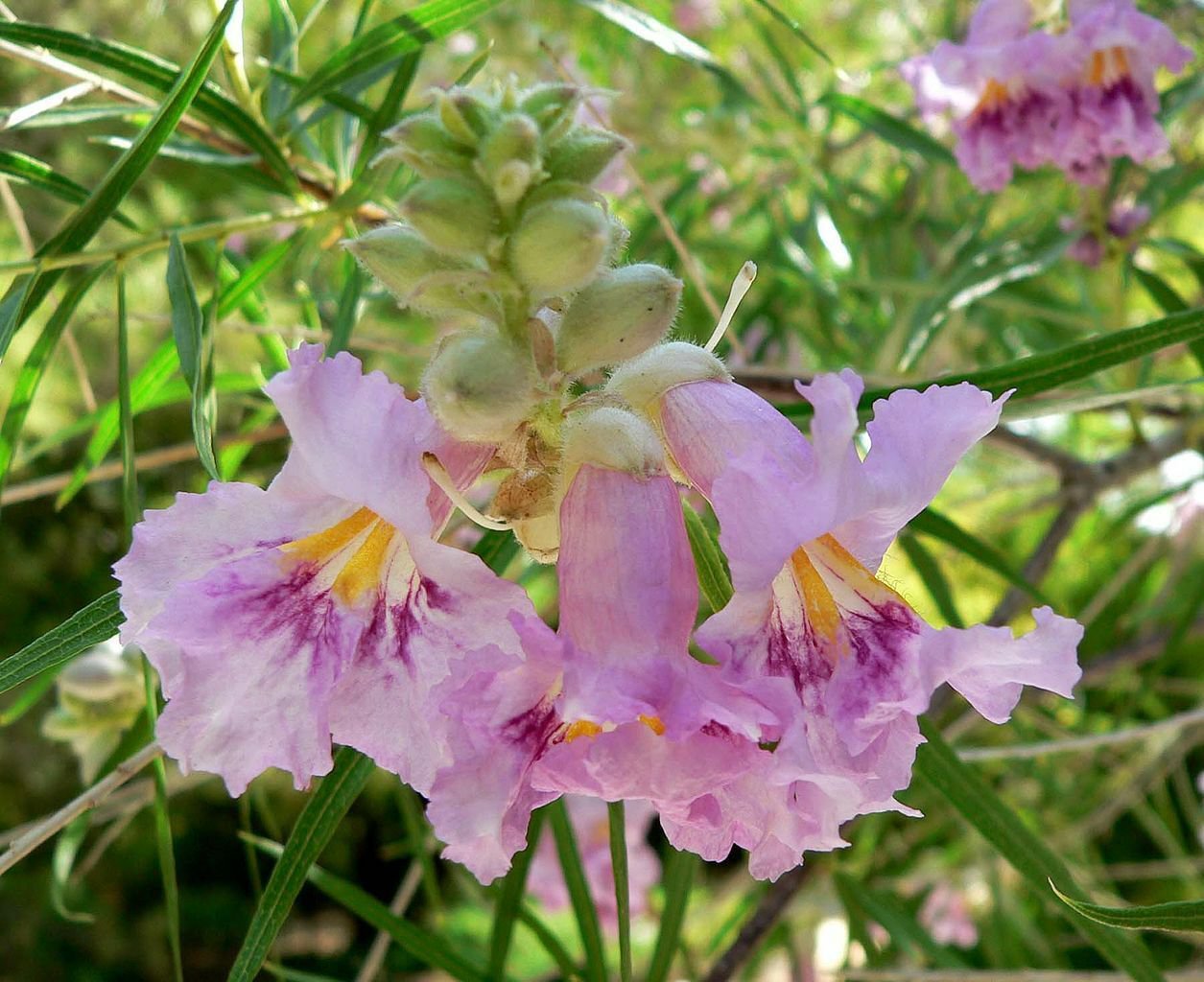
Flower: Attractive, bell shaped, 1 inch long, white to pale lavender with purple and yellow streaks inside throat, appear in long clusters at the ends of twigs in late spring and summer.
Fruit: Long thin slightly twisted brown capsule, 6 to 12 inches long, containing numerous fluffy, winged seeds, ripen in fall.
Twig: Slender, initially green turning gray-brown, buds are very small.
Bark: Gray-brown with lighter colored cracks and splits, later develops shallow furrows and becomes scaly.
Form: Large shrub to small tree, reaches heights of 30 feet, often with a twisted crown.
Zone: 7 to 11 (Hardy to -3 degrees Fahrenheit)
Growth Rate: Fast to Moderate
Plant Type: Deciduous shrub or tree
Family: Bignoniaceae
Native Range: North America
Height: 14 to 40 feet
Spread: 10 to 20 feet
Shape: Rounded, Spreading
Bloom Time: Spring thru Fall
Sun: Full Sun
Fall Color: None
Drought Tolerance: High. Can survive on as little as 10 inches a year of rainfall.
Water: Low
Maintenance: Low
Site Requirements /Soil Tolerances: Plant Desert Willow tree in full sun or partial shade. It will tolerate various soil conditions but does best in soil that drains well. Too much water will cause Desert Willow to get root rot, so allow the soil to dry out completely before watering again, or amend the planting hole with fast draining soil.
Culture: For the first year, water Desert Willow deeply every five to seven days. Water established Desert Willow trees every two weeks in the summer and every month in the winter. Prune in spring just as leaves emerge to remove winter damage. To maintain a single trunk, prune only the lowest limbs every spring until the tree is as tall as you want it.
Uses: Container or above-ground planter; recommended for buffer strips around parking lots or
for median strip plantings in the highway; near a deck or patio; reclamation plant; specimen.
Desert Willow can be left as a shrub, or trained into a tree with several trunks. They take well to trimming so they can also be used as hedges.
Sowing Chilopsis linearis Seeds:
For best results, please follow the instructions in the order provided.
Scarify: Soak in water for 24 hours
Stratify: None
Germination: Sow 1/4” Deep, Keep Moist, (Not wet).
Flower: Attractive, bell shaped, 1 inch long, white to pale lavender with purple and yellow streaks inside throat, appear in long clusters at the ends of twigs in late spring and summer.
Fruit: Long thin slightly twisted brown capsule, 6 to 12 inches long, containing numerous fluffy, winged seeds, ripen in fall.
Twig: Slender, initially green turning gray-brown, buds are very small.
Bark: Gray-brown with lighter colored cracks and splits, later develops shallow furrows and becomes scaly.
Form: Large shrub to small tree, reaches heights of 30 feet, often with a twisted crown.
Zone: 7 to 11 (Hardy to -3 degrees Fahrenheit)
Growth Rate: Fast to Moderate
Plant Type: Deciduous shrub or tree
Family: Bignoniaceae
Native Range: North America
Height: 14 to 40 feet
Spread: 10 to 20 feet
Shape: Rounded, Spreading
Bloom Time: Spring thru Fall
Sun: Full Sun
Fall Color: None
Drought Tolerance: High. Can survive on as little as 10 inches a year of rainfall.
Water: Low
Maintenance: Low
Site Requirements /Soil Tolerances: Plant Desert Willow tree in full sun or partial shade. It will tolerate various soil conditions but does best in soil that drains well. Too much water will cause Desert Willow to get root rot, so allow the soil to dry out completely before watering again, or amend the planting hole with fast draining soil.
Culture: For the first year, water Desert Willow deeply every five to seven days. Water established Desert Willow trees every two weeks in the summer and every month in the winter. Prune in spring just as leaves emerge to remove winter damage. To maintain a single trunk, prune only the lowest limbs every spring until the tree is as tall as you want it.
Uses: Container or above-ground planter; recommended for buffer strips around parking lots or
for median strip plantings in the highway; near a deck or patio; reclamation plant; specimen.
Desert Willow can be left as a shrub, or trained into a tree with several trunks. They take well to trimming so they can also be used as hedges.
Sowing Chilopsis linearis Seeds:
For best results, please follow the instructions in the order provided.
Scarify: Soak in water for 24 hours
Stratify: None
Germination: Sow 1/4” Deep, Keep Moist, (Not wet).
Other Products from warsini (View All)
-
$20.80

-
$20.80

-
$19.98

-
$19.98

-
$19.98

-
$19.98
-
$19.98
-
$19.98

-
$19.98

-
$19.98


 ID, Jawa Tengah
