
$19.17
Add to Cart
Video Toaster Flyer Manual 4.1B, NEW FACTORY SEALED, Commodore Amiga NewTek
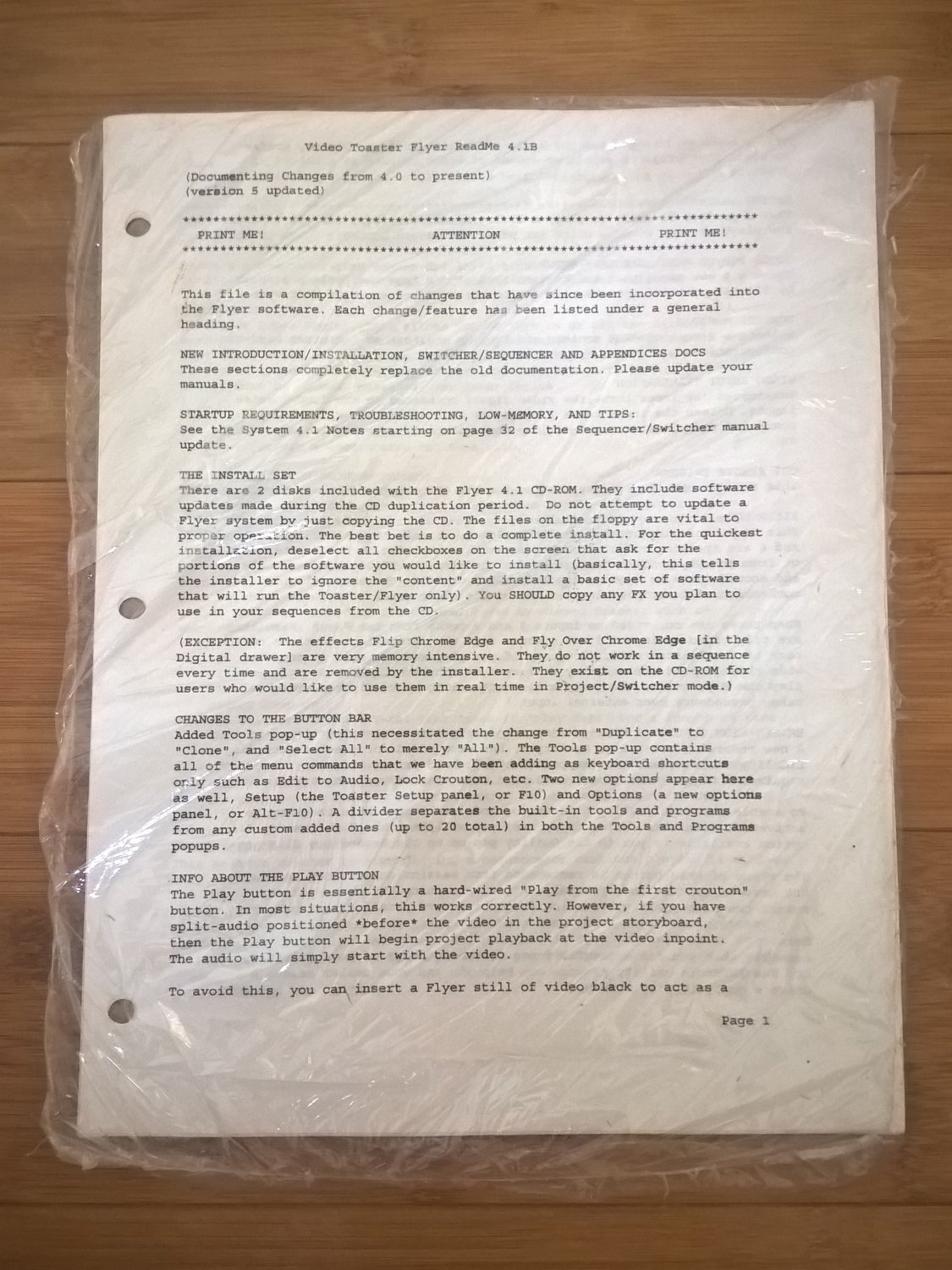


Appearance: NEW FACTORY SEALED, loose shrink-wrap
Description:
============
As pictured, a Video Toaster Flyer ReadMe 4.1B. This is just the "ReadMe" portion of the documentation - no other manuals are available.
Warranty and Returns:
=====================
We understand that there may be compatibility issues, space constraints, or it just doesn’t look perfect. This item can be returned within 14-days for ANY reason. However, shipping to and from is not refundable.
Shipping:
=========
- Other shipping methods are available – contact us for details.
- Combined shipping is available for most items – contact us for details.
- Local pickup is also available at no cost.
About Us:
=========
The Computer Preservation Group is dedicated to the preservation of historical computers. To help fund ongoing operations, select items are made available. To learn more, please visit our website: www.computerpreservation.com. Thank you for your support!
Stock#:C2922.LR#.33
Details from https://en.wikipedia.org/wiki/Video_Toaster#Video_Toaster_Flyer:
For the second generation NewTek introduced the Video Toaster Flyer. The Flyer is a much more capable non-linear editing system. In addition to just processing live video signals, the Flyer makes use of hard drives to store video clips as well as audio and allow complex scripted playback. The Flyer is capable of simultaneous dual-channel playback, which allows the Toaster's video switcher to perform transitions and other effects on video clips without the need for rendering.
The hardware component is again a card designed for the Amiga's Zorro II expansion slot, and was primarily designed by Charles Steinkuehler. The Flyer portion of the Video Toaster/Flyer combination is a complete computer of its own, having its own microprocessor and embedded software, which was written by Marty Flickinger. Its hardware includes three embedded SCSI controllers. Two of these SCSI buses are used to store video data, and the third to store audio. The hard drives are thus connected to the Flyer directly and use a proprietary filesystem layout, rather than being connected to the Amiga's buses and were available as regular devices using the included DOS driver. The Flyer uses a proprietary wavelet compression algorithm known as VTASC, which was well-regarded at the time for offering better visual quality than comparable motion-JPEG-based nonlinear editing systems.
One of the card's primary uses is for playing back LightWave 3D animations created in the Toaster.
Description:
============
As pictured, a Video Toaster Flyer ReadMe 4.1B. This is just the "ReadMe" portion of the documentation - no other manuals are available.
Warranty and Returns:
=====================
We understand that there may be compatibility issues, space constraints, or it just doesn’t look perfect. This item can be returned within 14-days for ANY reason. However, shipping to and from is not refundable.
Shipping:
=========
- Other shipping methods are available – contact us for details.
- Combined shipping is available for most items – contact us for details.
- Local pickup is also available at no cost.
About Us:
=========
The Computer Preservation Group is dedicated to the preservation of historical computers. To help fund ongoing operations, select items are made available. To learn more, please visit our website: www.computerpreservation.com. Thank you for your support!
Stock#:C2922.LR#.33
Details from https://en.wikipedia.org/wiki/Video_Toaster#Video_Toaster_Flyer:
For the second generation NewTek introduced the Video Toaster Flyer. The Flyer is a much more capable non-linear editing system. In addition to just processing live video signals, the Flyer makes use of hard drives to store video clips as well as audio and allow complex scripted playback. The Flyer is capable of simultaneous dual-channel playback, which allows the Toaster's video switcher to perform transitions and other effects on video clips without the need for rendering.
The hardware component is again a card designed for the Amiga's Zorro II expansion slot, and was primarily designed by Charles Steinkuehler. The Flyer portion of the Video Toaster/Flyer combination is a complete computer of its own, having its own microprocessor and embedded software, which was written by Marty Flickinger. Its hardware includes three embedded SCSI controllers. Two of these SCSI buses are used to store video data, and the third to store audio. The hard drives are thus connected to the Flyer directly and use a proprietary filesystem layout, rather than being connected to the Amiga's buses and were available as regular devices using the included DOS driver. The Flyer uses a proprietary wavelet compression algorithm known as VTASC, which was well-regarded at the time for offering better visual quality than comparable motion-JPEG-based nonlinear editing systems.
One of the card's primary uses is for playing back LightWave 3D animations created in the Toaster.


