
$17.31
Add to Cart
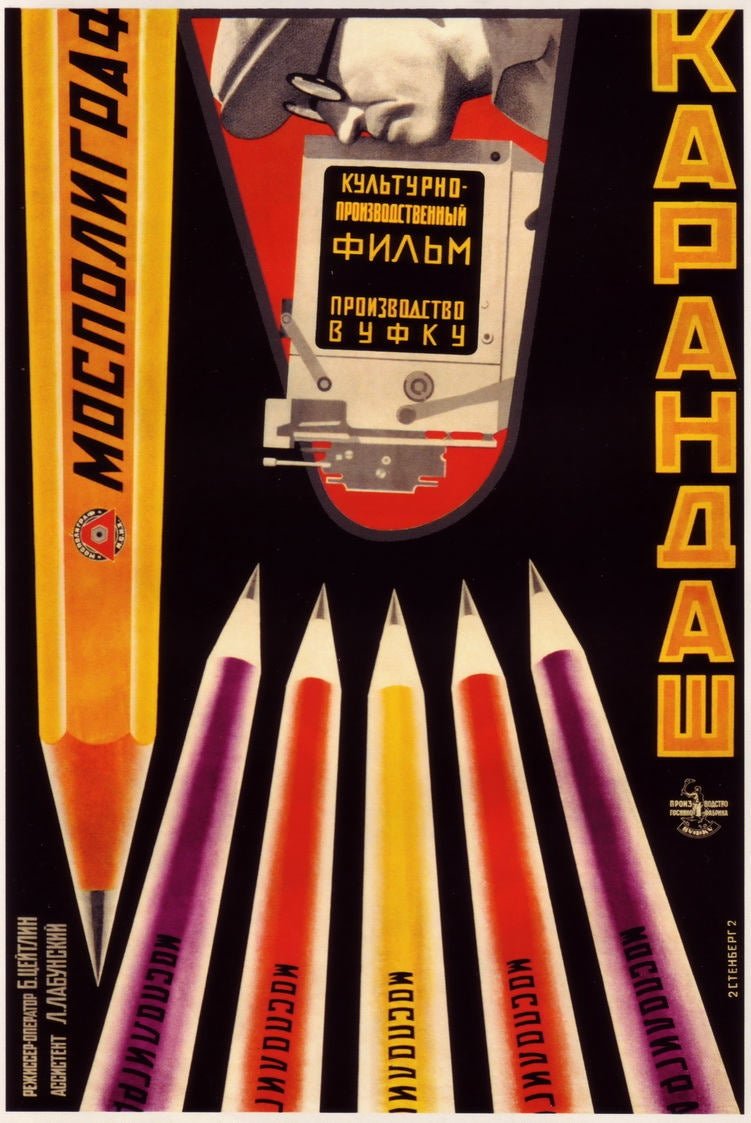
Soviet Constructivist posters / Karandash "Mospoligraph" / Moscow, 1928
Soviet Constructivist posters
Vladimir Stenberg (1899-1982)
Georgiy Stenberg (1900-1933)
Karandash "Mospoligraph"
Moscow, 1928
297 * 420 mm (11,7 x 16,5 inch)
Critics unanimously recognized the work of the Stenberg brothers at the second film poster exhibition. Their works organically combined the intensity of political propaganda with the festive decorations of the theater (in the 1920s, they were actively working with the A. Tairov Chamber Theatre), the aesthetic principles of constructivism and the subtle appearance of images in screenwriting. Their imaginative posters, which use a variety of viewpoints, unusual angles, different planes, direct and inverse perspective and large photographic fragments not only gave birth to a new, sharp and expressive poster language, but also accurately conveyed the director‘s ideas and the operator’s skill. The documentary pathos of Dziga Vertov (“The Eleventh”, 1928), the educational and informative ideas of a new special genre of "cultural production" films (“Pencil”, 1928) isn’t just readable in the Stenberg brothers‘ posters, but is transmitted through concise graphical language, with almost no repetition and amazing in its variety. In their works, they practically abandoned simple comparisons and sequential stories. In their constructed system of volumes and planes, pictorial metaphors and graphical associations, they primarily aimed to convey the movement, dynamics and rhythm that distinguished the 1920s with their characteristic call "Forward, time!”
Professionally Printed on Matte Paper
Your print will packaged in a poster tube to ensure its safely arrive.
Thank you for visiting!
Vladimir Stenberg (1899-1982)
Georgiy Stenberg (1900-1933)
Karandash "Mospoligraph"
Moscow, 1928
297 * 420 mm (11,7 x 16,5 inch)
Critics unanimously recognized the work of the Stenberg brothers at the second film poster exhibition. Their works organically combined the intensity of political propaganda with the festive decorations of the theater (in the 1920s, they were actively working with the A. Tairov Chamber Theatre), the aesthetic principles of constructivism and the subtle appearance of images in screenwriting. Their imaginative posters, which use a variety of viewpoints, unusual angles, different planes, direct and inverse perspective and large photographic fragments not only gave birth to a new, sharp and expressive poster language, but also accurately conveyed the director‘s ideas and the operator’s skill. The documentary pathos of Dziga Vertov (“The Eleventh”, 1928), the educational and informative ideas of a new special genre of "cultural production" films (“Pencil”, 1928) isn’t just readable in the Stenberg brothers‘ posters, but is transmitted through concise graphical language, with almost no repetition and amazing in its variety. In their works, they practically abandoned simple comparisons and sequential stories. In their constructed system of volumes and planes, pictorial metaphors and graphical associations, they primarily aimed to convey the movement, dynamics and rhythm that distinguished the 1920s with their characteristic call "Forward, time!”
Professionally Printed on Matte Paper
Your print will packaged in a poster tube to ensure its safely arrive.
Thank you for visiting!
Other Products from nrealn (View All)
-
$17.31
-
$17.31

-
$17.31
-
$17.31
-
$17.31
-
$17.31
-
$17.31
-
$17.31
-
$17.31
-
$17.31


 RU, Russia
