
$111.51
Add to Cart
Illya Darling Melina Mercouri - Original Cast Recording 1967 UA LEAR AMPEX Sealed A2 8-TRACK TAPE
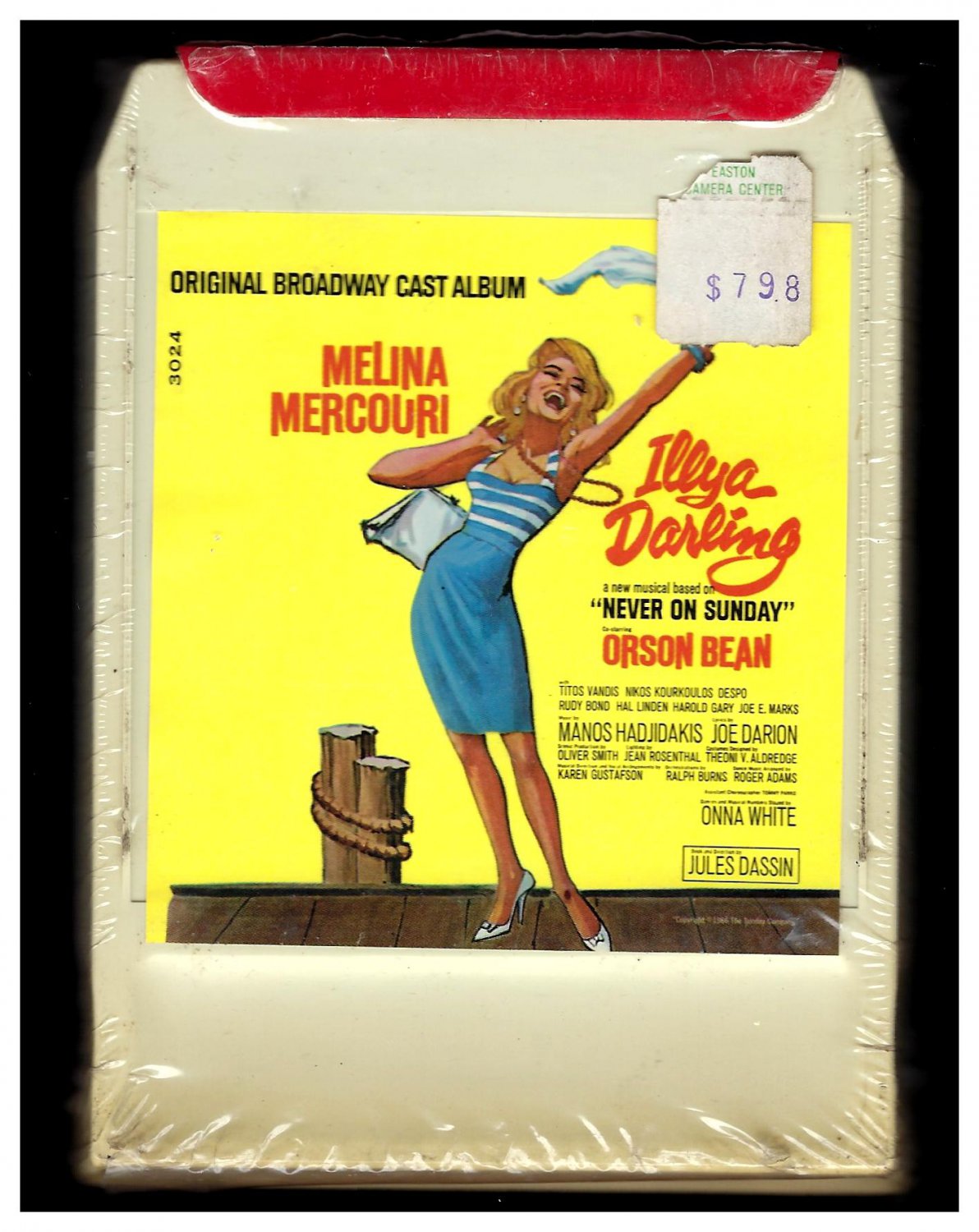


Illya Darling is a musical with a book by Jules Dassin, music by Manos Hadjidakis, and lyrics by Joe Darion, based on Dassin's 1960 film Never on Sunday.
The show previewed in a tour of Philadelphia, Toronto and Detroit for nine weeks. After 22 previews, the Broadway production opened on April 11, 1967 at the Mark Hellinger Theatre and closed on January 13, 1968, after 320 performances and 22 previews. It was directed by Dassin, choreographed by Onna White, with scenic design by Oliver Smith, costume design by Theoni V. Aldredge, and lighting design by Jean Rosenthal.
Attendance was fueled by the star wattage provided by Melina Mercouri, who was nominated for a Tony Award, in the title role. She had starred in the film, which managed to overcome the mostly lukewarm to negative reviews.[1] Critics found the plot too slight.[2]
Other cast members included Orson Bean as Homer Thrace, Nikos Kourkoulos (who was also nominated for a Tony) in his Broadway debut as Tonio, and Hal Linden as No Face. After closing on Broadway, the show went on tour with Cyd Charisse as Illya.[3]
The production was nominated for six Tony Awards, including Best musical, score, direction and choreography, but it did not win any.
The musical was presented by the Greek American Theatre Company of Los Angeles, running March 2003 to May 2003.
Maria Amalia Mercouri (Greek: Μαρία Αμαλία Μερκούρη; 31 October 1920 – 6 March 1994), known professionally as Melina Mercouri (Μελίνα Μερκούρη), was a Greek actress, singer and politician.
Mercouri was born in 1920 to a former cavalry officer and member of the Greek parliament, Stamatis Mercouris, and his wife, Eirini Lappa. When she completed her secondary education, she attended the National Theatre's Drama School, graduating in 1944. Mercouri's first husband was a wealthy landowner, Panos Harokopos; the couple divorced in 1962.
As an actress, Mercouri made her film debut in Stella (1955) and met international success with her performances in Never on Sunday (1960, with future husband Jules Dassin), Phaedra, Topkapi, and Promise at Dawn. She won the award for Best Actress at the 1960 Cannes Film Festival. She was nominated for an Academy Award, a Tony Award, three Golden Globe Awards, and two BAFTA Awards.
A political activist during the Greek military junta of 1967–1974, Mercouri became a member of the Hellenic Parliament in 1977 and became the first female Minister for Culture of Greece in 1981. In 1983, Mercouri proposed the programme of the European Capital of Culture, which was established by the European Union in 1985.
Mercouri was a strong advocate for the return to Athens of the Parthenon Marbles, which were removed from the Parthenon, and are now displayed in the British Museum in London
After her graduation, Mercouri joined the National Theatre of Greece and played the role of Electra in Eugene O'Neill's play Mourning Becomes Electra in 1945. In 1949, she had her first major success in the theatre playing Blanche DuBois in A Streetcar Named Desire, written by Tennessee Williams and staged by Karolos Koun's Art Theatre. Until 1950, she also worked in the same theatre in other plays by Aldous Huxley, Arthur Miller and André Roussin.
Mercouri then moved to Paris, where she appeared in boulevard plays by Jacques Deval and Marcel Achard, and met famous French playwrights and novelists such as Jean Cocteau, Jean-Paul Sartre, Colette and Françoise Sagan. In 1953, Mercouri received the Marika Kotopouli Prize.
Mercouri returned to Greece in 1955. At the Kotopouli-Rex Theatre, Mercouri starred in Macbeth by William Shakespeare and L'Alouette by Jean Anouilh.
Mercouri's first movie was the Greek language film Stella (1955), directed by Zorba the Greek director Michael Cacoyannis. The film received special praise at the 1956 Cannes Film Festival, where she met American film director Jules Dassin, with whom she would share not only her career but also her life. Their first professional pairing was 1957's He Who Must Die. Other films by Dassin and featuring Mercouri followed, such as The Law (1959).
Mercouri became well-known to international audiences when she starred in Never on Sunday (1960), in which Dassin was the director and co-star. For this film, she earned the Best Actress Award at the 1960 Cannes Film Festival and was nominated for the Academy Award for Best Actress and the BAFTA Award for Best Actress in a Leading Role.
After her first major international success, Mercouri went on to star in Phaedra (1962), for which she was nominated again for the BAFTA Award and the Golden Globe Award for Best Actress in Motion Picture Drama. The recognition of her acting talent did not stop though, as her role in Topkapi (1964) granted her one more nomination, this time for the Golden Globe Award for Best Actress in Motion Picture Musical or Comedy. Mercouri worked with such directors as Joseph Losey, Vittorio De Sica, Ronald Neame, Carl Foreman, Norman Jewison, and starred in films like Spanish language The Uninhibited by Juan Antonio Bardem.
Mercouri continued her stage career in the Greek production of Tennessee Williams's Sweet Bird of Youth (1960), under the direction of Karolos Koun. In 1967, she played the leading role in Illya Darling (from 11 April 1967 to 13 January 1968) on Broadway, for which she was nominated for the Tony Award for Best Performance by a Leading Actress in a Musical. Mercouri's performance in Promise at Dawn (1970) earned her another Golden Globe Award nomination.
On 8 October 1962, Mercouri appeared on the American TV show What's My Line. After the panel were blindfolded, a strange man appeared on-stage and proclaimed himself "the second mystery guest". Host John Charles Daly quickly called for "the relieving unit" and said "schedule two" (a coded phrase used on live broadcasts in case of an emergency: the cameras are turned to a neutral position and the sound is cut off). The man talked a bit about a dating service he apparently owned before being hustled off the stage by announcer Johnny Olson and executive producer Gil Fates. Daly apologized to the panel and the program continued.
Mercouri concentrated on her stage career for the following years, playing in the Greek productions of The Threepenny Opera and, for a second time, Sweet Bird of Youth, in addition to the ancient Greek tragedies Medea and Oresteia. She retired from film acting in 1978, when she played in her last film, A Dream of Passion, directed by her husband, Jules Dassin. Mercouri's last performance on stage was in the opera Pylades at the Athens Concert Hall in 1992, portraying Clytemnestra.
Retrieved from
https://en.wikipedia.org/wiki/Melina_Mercouri
A2
Because this tape is sealed new and we cannot inspect for play-ability, we offer no warranty or guarantees on how well this tape will perform once it is opened and removed from the cellophane package. Because this sealed new 8-track tape is very old, the foam pad and glue on the foil splice most often has a tendency to deteriorate over many years of time. Because this tape is a mid 1960's tape, the pinch roller more than likely has deteriorated and will also will need to be replaced. Please be sure to inspect and replace if necessary those items before playing any sealed new 8-track tape, or damage to the tape and player may occur.
If you would like this new sealed tape gently opened and restored to full play-ability with a pinch roller, new pad and a foil splice added. Please go to "New 8-track tape repair" in the New 8-track tape category and we will gladly perform the work for you. Please be sure to select 4 for the number of repairs needed for us to professionally restore this tape to full play-ability. Also, please be sure to select the number required for any additional new sealed 8-track tapes you may be purchasing.
The show previewed in a tour of Philadelphia, Toronto and Detroit for nine weeks. After 22 previews, the Broadway production opened on April 11, 1967 at the Mark Hellinger Theatre and closed on January 13, 1968, after 320 performances and 22 previews. It was directed by Dassin, choreographed by Onna White, with scenic design by Oliver Smith, costume design by Theoni V. Aldredge, and lighting design by Jean Rosenthal.
Attendance was fueled by the star wattage provided by Melina Mercouri, who was nominated for a Tony Award, in the title role. She had starred in the film, which managed to overcome the mostly lukewarm to negative reviews.[1] Critics found the plot too slight.[2]
Other cast members included Orson Bean as Homer Thrace, Nikos Kourkoulos (who was also nominated for a Tony) in his Broadway debut as Tonio, and Hal Linden as No Face. After closing on Broadway, the show went on tour with Cyd Charisse as Illya.[3]
The production was nominated for six Tony Awards, including Best musical, score, direction and choreography, but it did not win any.
The musical was presented by the Greek American Theatre Company of Los Angeles, running March 2003 to May 2003.
Maria Amalia Mercouri (Greek: Μαρία Αμαλία Μερκούρη; 31 October 1920 – 6 March 1994), known professionally as Melina Mercouri (Μελίνα Μερκούρη), was a Greek actress, singer and politician.
Mercouri was born in 1920 to a former cavalry officer and member of the Greek parliament, Stamatis Mercouris, and his wife, Eirini Lappa. When she completed her secondary education, she attended the National Theatre's Drama School, graduating in 1944. Mercouri's first husband was a wealthy landowner, Panos Harokopos; the couple divorced in 1962.
As an actress, Mercouri made her film debut in Stella (1955) and met international success with her performances in Never on Sunday (1960, with future husband Jules Dassin), Phaedra, Topkapi, and Promise at Dawn. She won the award for Best Actress at the 1960 Cannes Film Festival. She was nominated for an Academy Award, a Tony Award, three Golden Globe Awards, and two BAFTA Awards.
A political activist during the Greek military junta of 1967–1974, Mercouri became a member of the Hellenic Parliament in 1977 and became the first female Minister for Culture of Greece in 1981. In 1983, Mercouri proposed the programme of the European Capital of Culture, which was established by the European Union in 1985.
Mercouri was a strong advocate for the return to Athens of the Parthenon Marbles, which were removed from the Parthenon, and are now displayed in the British Museum in London
After her graduation, Mercouri joined the National Theatre of Greece and played the role of Electra in Eugene O'Neill's play Mourning Becomes Electra in 1945. In 1949, she had her first major success in the theatre playing Blanche DuBois in A Streetcar Named Desire, written by Tennessee Williams and staged by Karolos Koun's Art Theatre. Until 1950, she also worked in the same theatre in other plays by Aldous Huxley, Arthur Miller and André Roussin.
Mercouri then moved to Paris, where she appeared in boulevard plays by Jacques Deval and Marcel Achard, and met famous French playwrights and novelists such as Jean Cocteau, Jean-Paul Sartre, Colette and Françoise Sagan. In 1953, Mercouri received the Marika Kotopouli Prize.
Mercouri returned to Greece in 1955. At the Kotopouli-Rex Theatre, Mercouri starred in Macbeth by William Shakespeare and L'Alouette by Jean Anouilh.
Mercouri's first movie was the Greek language film Stella (1955), directed by Zorba the Greek director Michael Cacoyannis. The film received special praise at the 1956 Cannes Film Festival, where she met American film director Jules Dassin, with whom she would share not only her career but also her life. Their first professional pairing was 1957's He Who Must Die. Other films by Dassin and featuring Mercouri followed, such as The Law (1959).
Mercouri became well-known to international audiences when she starred in Never on Sunday (1960), in which Dassin was the director and co-star. For this film, she earned the Best Actress Award at the 1960 Cannes Film Festival and was nominated for the Academy Award for Best Actress and the BAFTA Award for Best Actress in a Leading Role.
After her first major international success, Mercouri went on to star in Phaedra (1962), for which she was nominated again for the BAFTA Award and the Golden Globe Award for Best Actress in Motion Picture Drama. The recognition of her acting talent did not stop though, as her role in Topkapi (1964) granted her one more nomination, this time for the Golden Globe Award for Best Actress in Motion Picture Musical or Comedy. Mercouri worked with such directors as Joseph Losey, Vittorio De Sica, Ronald Neame, Carl Foreman, Norman Jewison, and starred in films like Spanish language The Uninhibited by Juan Antonio Bardem.
Mercouri continued her stage career in the Greek production of Tennessee Williams's Sweet Bird of Youth (1960), under the direction of Karolos Koun. In 1967, she played the leading role in Illya Darling (from 11 April 1967 to 13 January 1968) on Broadway, for which she was nominated for the Tony Award for Best Performance by a Leading Actress in a Musical. Mercouri's performance in Promise at Dawn (1970) earned her another Golden Globe Award nomination.
On 8 October 1962, Mercouri appeared on the American TV show What's My Line. After the panel were blindfolded, a strange man appeared on-stage and proclaimed himself "the second mystery guest". Host John Charles Daly quickly called for "the relieving unit" and said "schedule two" (a coded phrase used on live broadcasts in case of an emergency: the cameras are turned to a neutral position and the sound is cut off). The man talked a bit about a dating service he apparently owned before being hustled off the stage by announcer Johnny Olson and executive producer Gil Fates. Daly apologized to the panel and the program continued.
Mercouri concentrated on her stage career for the following years, playing in the Greek productions of The Threepenny Opera and, for a second time, Sweet Bird of Youth, in addition to the ancient Greek tragedies Medea and Oresteia. She retired from film acting in 1978, when she played in her last film, A Dream of Passion, directed by her husband, Jules Dassin. Mercouri's last performance on stage was in the opera Pylades at the Athens Concert Hall in 1992, portraying Clytemnestra.
Retrieved from
https://en.wikipedia.org/wiki/Melina_Mercouri
A2
Because this tape is sealed new and we cannot inspect for play-ability, we offer no warranty or guarantees on how well this tape will perform once it is opened and removed from the cellophane package. Because this sealed new 8-track tape is very old, the foam pad and glue on the foil splice most often has a tendency to deteriorate over many years of time. Because this tape is a mid 1960's tape, the pinch roller more than likely has deteriorated and will also will need to be replaced. Please be sure to inspect and replace if necessary those items before playing any sealed new 8-track tape, or damage to the tape and player may occur.
If you would like this new sealed tape gently opened and restored to full play-ability with a pinch roller, new pad and a foil splice added. Please go to "New 8-track tape repair" in the New 8-track tape category and we will gladly perform the work for you. Please be sure to select 4 for the number of repairs needed for us to professionally restore this tape to full play-ability. Also, please be sure to select the number required for any additional new sealed 8-track tapes you may be purchasing.


