
$25.08
Add to Cart
1958 Philippine 5 Five Centavos Coin Brass KM187 1st Year Issued AU/Uncirculated
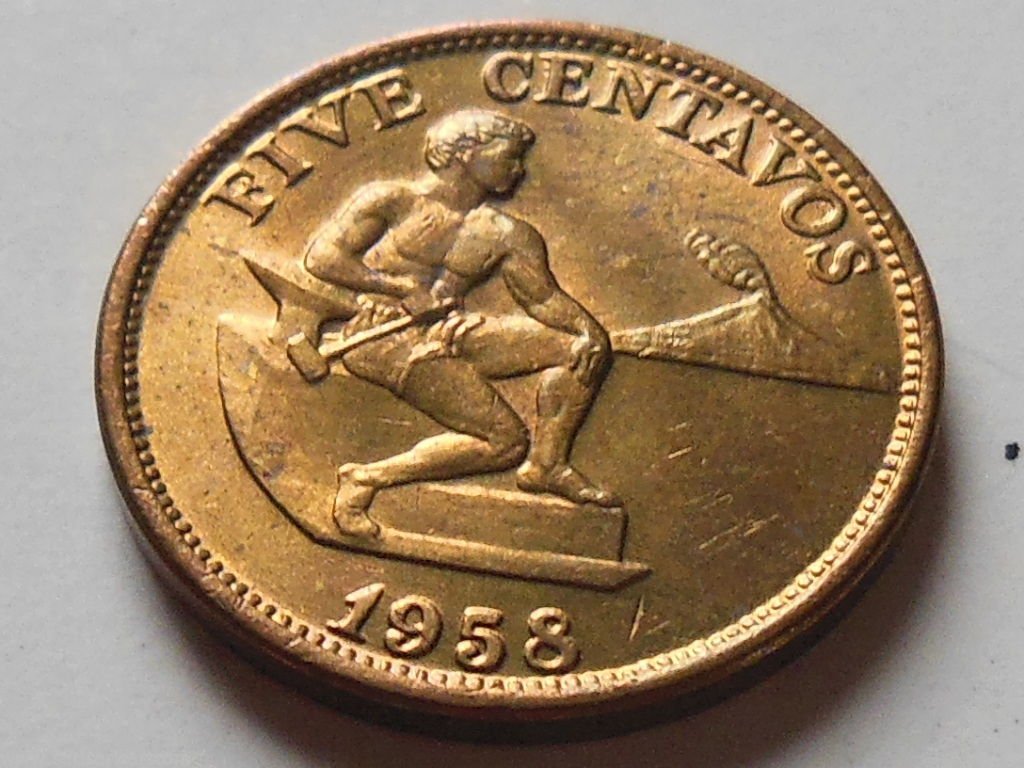


1958 Philippines 5 CentavosExact Coin Struck at the United States’ Philadelphia mint in 1958-66 for the Philippines. This type was accompanied by one, ten, twenty-five and fifty centavos which used the old commonwealth designs but were struck in base metal.20,000,000 Minted ObverseShield of arms, ribbon below with motto Lettering: CENTRAL BANK OF THE PHILIPPINESREPUBLIC OF THE PHILIPPINES ReverseMale seated beside hammer and anvil. An active volcano (Mt. Mayon) on right in background, date below Lettering: FIVE CENTAVOS FeaturesCountry Philippines Years 1958-1966Value 5 Centavos (0.05 PHP)Metal BrassWeight 4.8 gDiameter 21 mmThickness 1.7 mmShape RoundOrientation Coin alignment ↑↓Demonetized yesReferences KM# 187 Exact Coin, Please See Coin For Grading and Overall Condition. First 12 Years As a Republic; Almost No Coins:Once the Philippines was now its own independent nation and no longer a Commonwealth or Territory, yet another symbol would come to serve as their national Coat of Arms. The first appearance of this new Coat of Arms on a coin would come the very next year. In 1947 a pair of MacArthur commemorative s were minted in San Francisco, namely the 50 Centavos and 1 Peso. These coins were only struck for collectors, but in large numbers, and are quite commonly found today.For the next more than a decade however, no new coins were struck for the Philippines for use in commerce. The vast number of coins struck in the closing years of the Commonwealth era served well for quite some time, the base metal coins continuing to circulate widely well into the 1960s, though the silver denominations had pretty much disappeared from circulation by that time. But once the Philippines became its own nation, the ratio of two Pesos to one US Dollar was very quickly abandoned and inflation quickly became a problem. Starting in 1949 once the Bank of the Philippines was officially chartered, fractional paper notes, in a smaller size and denominations of 5, 10, 20, and 50 Centavos were printed, alongside the higher denomination notes. In circulation these tended to wear out quickly and time came that coins would again be issued for the Philippines. This was not the first introduction of paper fractional notes, since during World War II the invading Japanese also printed fractional currency notes for the Philippines, as did several of the hidden native sources of the Philippine Guerilla currency.The Introduction and Rise of the So-Called English Series, Struck in the US:In 1958, the new Philippine coinage would at last be unveiled, still retaining the original seated man and standing woman designs of Melecio Figueroa as originally issued in 1903 for one side (but now with the date on that side), and the Philippines government Coat of Arms on the reverse. While 20 million 1 Centavo coins and 10 million 5 Centavo coins were struck in that first year, only 1 thousand of each of 10, 25, and 50 Centavos were struck, with perhaps some small percentage of those being proofs. This effectively ended the 20 Centavos denomination, as a new 25 Centavos denomination took its place and has done so ever since. These new coins were all minted in the same sizes as their US American equivalent denominations, but only the 1 Centavo in the same alloy as the American 1 Cent. The 5 Centavos was issued in bright yellow brass, and the 10 through 50 Centavos denominations were issued in copper-nickel, and through 1963, all of these coins were struck at the Philadelphia mint.The small numbers of 1958 10, 25, and 50 Centavos coins seemed to create an instant rarity at the time, but in 1959 the same dies, with the same dates, simply continued to be used for the remainder of 10 million of the 10 and 25 Centavos denominations and 5 million of the 50 Centavos denomination. Another 10 million 5 Centavos were also minted that year, these being the only Philippine coins to bear the 1959 date. But this motif of minting foreign coins at least sometimes in a different year than from that on the coins continued. Half of the 40 million 1 Centavo coins dated 1960 were actually minted in 1961, together with all 40 million 5 Centavos coins dated 1960. 40 million of the 70 million total 10 Centavos coins dated 1960 were also minted in 1961.The only Philippine coins actually bearing the 1961 date however are a pair of commemorative coins honoring the Philippine National Hero, José Rizal. Along with a Peso struck in silver and being the same size as a standard US silver dollar (smaller sizes instituted for all silver as of 1907 finally being abandoned), for the first and only time, the 50 Centavo was actually self-described as a Half Peso instead. The Half Peso was the same size and standards as a regular 1961 US Half Dollar. These, and the next several commemorative coins are actually quite common and inexpensive, but for some unknown reason all of these 1961 commemoratives (and also those dated 1963 honoring Andrés Bonifacio and 1964 honoring Apolinario Mabini) are virtually all seriously afflicted with bag marks, nicks, and scratches. If ever a clean specimen of any of these without such marks should ever emerge anywhere, it could be worth quite a bit.Later English Series Philippine Coins Struck In England and Germany:For 1962 and 1963, the coins were finally struck in the year stated on the coin, with the only exception being that 23,515,000 of the 30 million 1 Centavos coins dated 1962 were struck in 1963. For 1964, dies for all Philippine denominations were prepared for the minting of more coins, but with the coin shortage the US mint could no longer manufacture any coins for foreign nations. When it became clear that the same would go for 1965 as well, the dies were sent to England, so all Philippine coins dated 1964 (including the 1964 Mabini commemorative and even the 1963-dated Bonifacio commemorative) were all struck in the British Royal Mint in Tower Hill, London, in 1965. By this time however, between the inflation of the Philippine Peso and the rising price of copper, it was no longer cost effective to mint any 1 Centavo coins, so that denomination didn’t get minted again in this era since 1963. The other denominations from 5 to 50 Centavos were all issued in the same standards as was introduced in 1958.For 1966, the coin shortage continued to render the US mint virtually incapable of providing any coins for foreign nations (though the US Mint in San Francisco did make one production run of Quarter Balboa coins for Panama that year), and again the Royal Mint was employed, this time supplemented with help from the Vereinigte Deutsche Metallwerke mint in West Germany. It appears that the division of labor was that the 5 Centavos was struck in England, the 10 Centavos in Germany, and the 25 Centavos struck in both places. This resulted in two different versions of the 1966 25 Centavo coin, sometimes referred to as “8 Smoke Rings” (England version) and “6 Smoke Rings” (German version). In the German version, the standing lady takes on an extremely Teutonic appearance never otherwise seen on any Philippine coins (except the concurrent 1966 10 Centavos). This would be the last time these historic 1903 designs would be used, though they do make a brief appearance on a commemorative coin issued in 1977.Introduction and Rise of Pilipino Series, Mostly Struck in the US:Up until this point, Philippine coins had always bore inscriptions in the language of the ruling or dominant nation/culture. The Spanish era coins all bore Spanish inscriptions or abbreviations; the American era coins (and even the independent Republic era coins up through 1966, and even extending into a single commemorative in 1967) all bore English inscriptions (apart from what Spanish words such as “Filipinas” or “Centavo” or “Peso” were sustained by the Americans). It was time to introduce a truly native Philippine coin series, this time using the native language of Tagalog, or as they called it locally, “Pilipino.” As a result of this change, the 1958-1966 coins retroactively acquired the title of “English Series,” as contrasted with what came after it which is called the “Pilipino Series.” Similar phrases also apply to the paper currency which was going through a similar transition at roughly the same time.A New Kind of Philippine Money for Every Decade:By this time another pattern was emerging, one that actually got its start in the 1930s. Recall that once the Americans had taken over, the designs remained unchanged (other than to be scaled for smaller size in five of the original seven denominations) clear until the arrival of the Commonwealth government. The Commonwealth design (introduced on the commemorative in 1936 and then all circulating denominations in 1937) was a major change in the appearance of the coins, despite the retention (for continuity) of size and alloy standards and the design on the other side. In 1949, the Commonwealth (and any remaining older) coinage monies gave way to the newly created Central Bank of the Philippines fractional notes. In 1958 the fractional notes were replaced with the new English Series coins. And in 1967 the English Series would be replaced with the Pilipino Series. The trend continues, however. In 1975 the Pilipino Series gives way to the “Ang Bagong Lipunan” (The New Society) Series. In 1983 the Bagong Lipunan Series gives way to the Flora and Fauna Series. In 1995 the Flora and Fauna Series gave way to what is, as of yet the time of this writing, the current BSP Series. The opening decade of the new millennium stands unique as the only decade since the 1920s that the Philippine coinage (or normally coinage-related denominations, as represented by fractional notes) was not wholesale replaced. As of this writing (early 2012), the same coins with the same standards as was first released in 1995 continue to be the current issue.Commentary: New Money For Old:Loosely connected to this continual changeover


 PH, Metro Manila
