
$17.75
Add to Cart
Bayon Temple Siem Reap, Cambodia, High Quality Souvenir Resin 3d Fridge Magnet
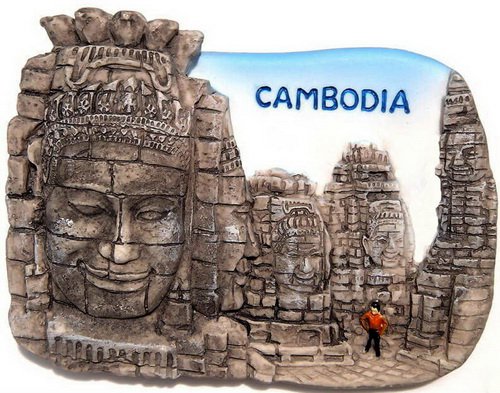


More than 10 available
Details
Shipping: Australia: free (more destinations)
Condition: Brand new
*The store has not been updated recently. You may want to contact the merchant to confirm the availability of the product.
Approximate Size Before Packing: 7.1 x 5.3 cm.
• This is originally handmade in Thailand, with premium quality products.
• Vintage design decorating gift souvenirs.
• Quantity 1 piece
• Free Shipping This item Ship Within 24 hrs. 100% New Product Guaranteed
There all Magnets are no substitute for the distinctive image of real-look magnets. Each design is hand-crafted with the finest detail and dimensional look. The colored areas are a combination of air-brushing and hand-painting on polyresin. Make a great addition to someone's magnet collection. It is a fabulous decoration, for any place you put it on.
Shipping
We ship Worldwide via airmail by Thailand Post. Item shipped from Thailand. Delivery Time: (Approximately) Normally it takes 1-3 weeks.
: UK/UE Take 1-3 Weeks
: US/Canada 12-28 days
: Asia /Australia 5-20 days
: France/South America/Africa 20-45 days
RETURN POLICY
Satisfaction Guarantee 100% Satisfaction Guarantee: If you are not satisfied with the product you purchased for any reason, please contact us for a return instruction within 30 days for a refund. Shipping Handling costs are not refundable. Return shipping costs will be paid by the buyer.
Contact Us
if you have any inquiries or face any Difficulty regarding all the processes. Please do not hesitate to contact me.
Email: [email protected]
BAYON
The Bayon is a well-known and richly decorated Khmer temple at Angkor in Cambodia. Built-in the late 12th or early 13th century as the official state temple of the Mahayana Buddhist King Jayavarman VII, the Bayon stands at the center of Jayavarman's capital, Angkor Thom. Following Jayavarman's death, it was modified and augmented by later Hindu and Theravada Buddhist kings in accordance with their own religious preferences.
The Bayon's most distinctive feature is the multitude of serene and smiling stone faces on the many towers which jut out from the upper terrace and cluster around its central peak. The temple is known also for two impressive sets of bas-reliefs, which present an unusual combination of mythological, historical, and mundane scenes. The current main conservatory body, the Japanese Government Team for the Safeguarding of Angkor (the JSA) has described the temple as "the most striking expression of the baroque style" of Khmer architecture, as contrasted with the classical style of Angkor Wat.
The Bayon was the last state temple to be built at Angkor, and the only Angkorian state temple to be built primarily as a Mahayana Buddhist shrine dedicated to the Buddha, though a great number of minor and local deities were also encompassed as representatives of the various districts and cities of the realm. It was the centerpiece of Jayavarman VII's massive program of monumental construction and public works, which was also responsible for the walls and nāga-bridges of Angkor Thom and the temples of Preah Khan, Ta Prohm, and Banteay Kdei.
From the vantage point of the temple's upper terrace, one is struck by "the serenity of the stone faces" occupying many towers.
The similarity of the 216 gigantic faces on the temple's towers to other statues of the king has led many scholars to the conclusion that the faces are representations of Jayavarman VII himself. Others have said that the faces belong to the bodhisattva of compassion called Avalokitesvara or Lokesvara. The two hypotheses need not be regarded as mutually exclusive. Angkor scholar George Coedès has theorized that Jayavarman stood squarely in the tradition of the Khmer monarchs in thinking of himself as a "deva raja" (god-king), the salient difference being that while his predecessors were Hindus and regarded themselves as consubstantial with Shiva and his symbol the lingam, Jayavarman as a Buddhist identified himself with the Buddha and the bodhisattva.
• This is originally handmade in Thailand, with premium quality products.
• Vintage design decorating gift souvenirs.
• Quantity 1 piece
• Free Shipping This item Ship Within 24 hrs. 100% New Product Guaranteed
There all Magnets are no substitute for the distinctive image of real-look magnets. Each design is hand-crafted with the finest detail and dimensional look. The colored areas are a combination of air-brushing and hand-painting on polyresin. Make a great addition to someone's magnet collection. It is a fabulous decoration, for any place you put it on.
Shipping
We ship Worldwide via airmail by Thailand Post. Item shipped from Thailand. Delivery Time: (Approximately) Normally it takes 1-3 weeks.
: UK/UE Take 1-3 Weeks
: US/Canada 12-28 days
: Asia /Australia 5-20 days
: France/South America/Africa 20-45 days
RETURN POLICY
Satisfaction Guarantee 100% Satisfaction Guarantee: If you are not satisfied with the product you purchased for any reason, please contact us for a return instruction within 30 days for a refund. Shipping Handling costs are not refundable. Return shipping costs will be paid by the buyer.
Contact Us
if you have any inquiries or face any Difficulty regarding all the processes. Please do not hesitate to contact me.
Email: [email protected]
BAYON
The Bayon is a well-known and richly decorated Khmer temple at Angkor in Cambodia. Built-in the late 12th or early 13th century as the official state temple of the Mahayana Buddhist King Jayavarman VII, the Bayon stands at the center of Jayavarman's capital, Angkor Thom. Following Jayavarman's death, it was modified and augmented by later Hindu and Theravada Buddhist kings in accordance with their own religious preferences.
The Bayon's most distinctive feature is the multitude of serene and smiling stone faces on the many towers which jut out from the upper terrace and cluster around its central peak. The temple is known also for two impressive sets of bas-reliefs, which present an unusual combination of mythological, historical, and mundane scenes. The current main conservatory body, the Japanese Government Team for the Safeguarding of Angkor (the JSA) has described the temple as "the most striking expression of the baroque style" of Khmer architecture, as contrasted with the classical style of Angkor Wat.
The Bayon was the last state temple to be built at Angkor, and the only Angkorian state temple to be built primarily as a Mahayana Buddhist shrine dedicated to the Buddha, though a great number of minor and local deities were also encompassed as representatives of the various districts and cities of the realm. It was the centerpiece of Jayavarman VII's massive program of monumental construction and public works, which was also responsible for the walls and nāga-bridges of Angkor Thom and the temples of Preah Khan, Ta Prohm, and Banteay Kdei.
From the vantage point of the temple's upper terrace, one is struck by "the serenity of the stone faces" occupying many towers.
The similarity of the 216 gigantic faces on the temple's towers to other statues of the king has led many scholars to the conclusion that the faces are representations of Jayavarman VII himself. Others have said that the faces belong to the bodhisattva of compassion called Avalokitesvara or Lokesvara. The two hypotheses need not be regarded as mutually exclusive. Angkor scholar George Coedès has theorized that Jayavarman stood squarely in the tradition of the Khmer monarchs in thinking of himself as a "deva raja" (god-king), the salient difference being that while his predecessors were Hindus and regarded themselves as consubstantial with Shiva and his symbol the lingam, Jayavarman as a Buddhist identified himself with the Buddha and the bodhisattva.
You may also be interested in:
-
$24.80

-
$31.44

-
$15.32

-
$8.36
-
$31.44
-
$32.64

-
$45.99

-
$90.62
-
$31.44

-
$29.13


 TH, -
TH, -
