
$4,175.33
Add to Cart
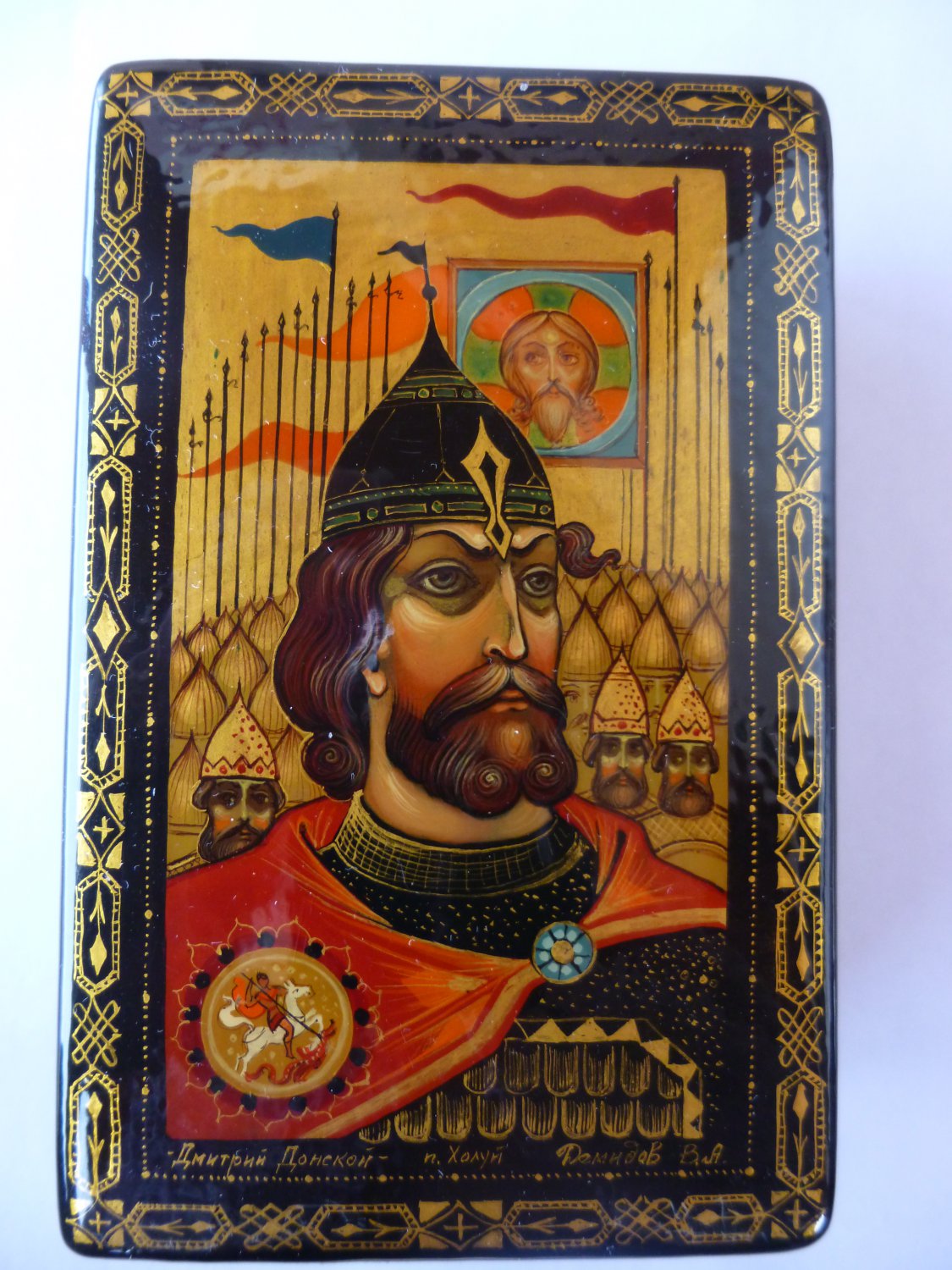
Russian Lacquer Box, artist Liliva Demidov. Kholui
More than 10 available
Details
Shipping: USPS calculated - check
Condition: Brand new
*The store has not been updated recently. You may want to contact the merchant to confirm the availability of the product.


Lacquer box, Dimitriy Donskoy, Kholui, Liliya Demidov
The box is painted in Kholui by Liliya Demidov and shows the story of Prince Dimitriy Donskoy with an icon of Jesus
The box, purchased in Russia in 1990, is extremely rare.
Measurements of the box, 3 inch x 2.5 inch x 1 inch.
In 1380 the prince of Moscow Dimitriy succeeded in defeating the Mongols in a major battle on the field of Kulikovo, near the Don River. Although the Mongols continued to rule in Russia for nearly 100 more years, this defeat of their armies laid to rest the belief in Mongol invincibility. Dimitriy Donskoi (Donskoi, meaning "of the Don River"), reigned in Moscow for nearly three decades until his death in 1389 at the age of thirty-nine. During his rule, the wooden walls of the Kremlin were replaced with stone walls in 1367; he twice withstood attacks by the Lithuanians and later defeated their army; and also gained victories over the Volga Bulgars, who paid tribute to the Golden Horde (Mongol rulers in Russia). After his death, Prince Dimitriy was canonized into the Russian Orthodox Church for the things he did for the Russian people and the way he lived in general. Icons of his image were painted as result of his new title as a Saint. The most common features painted on icons of Dmitriy are of him and his army. Dimitriy stands tall and firm in the foreground dressed in his full armor. An insignia of Saint George defeating the Dragon on his cape represents him as the prince of Moscow defeating his enemies. (This same theme was used in the statue Catherine II built for Peter the Great in St. Petersburg known as the Bronze Horseman.) Only a few of the soldiers in his icons are ever clear, and the rest are bunched behind them in iconographic disproportion. Rising above the army, there is often a flag with the image of Christ. This is a representation of the Russians' struggle against the Mongols not only as their oppressors, but also as pagans. Following the fall of Constantinople to the Islamic Turks, and surrounded by Muslims in the East and Catholics in the West, the people of Russia believed they were of the only true faith, and they gave Moscow the title of being the Third and Final Rome; Constantinople being the second. Information on Dimitriy Donskoi taken from Nicholas V. Riasonovsky, A History of Russia, Oxford University Press, 1993 (ISBN 0-19-507462-9).
The box is painted in Kholui by Liliya Demidov and shows the story of Prince Dimitriy Donskoy with an icon of Jesus
The box, purchased in Russia in 1990, is extremely rare.
Measurements of the box, 3 inch x 2.5 inch x 1 inch.
In 1380 the prince of Moscow Dimitriy succeeded in defeating the Mongols in a major battle on the field of Kulikovo, near the Don River. Although the Mongols continued to rule in Russia for nearly 100 more years, this defeat of their armies laid to rest the belief in Mongol invincibility. Dimitriy Donskoi (Donskoi, meaning "of the Don River"), reigned in Moscow for nearly three decades until his death in 1389 at the age of thirty-nine. During his rule, the wooden walls of the Kremlin were replaced with stone walls in 1367; he twice withstood attacks by the Lithuanians and later defeated their army; and also gained victories over the Volga Bulgars, who paid tribute to the Golden Horde (Mongol rulers in Russia). After his death, Prince Dimitriy was canonized into the Russian Orthodox Church for the things he did for the Russian people and the way he lived in general. Icons of his image were painted as result of his new title as a Saint. The most common features painted on icons of Dmitriy are of him and his army. Dimitriy stands tall and firm in the foreground dressed in his full armor. An insignia of Saint George defeating the Dragon on his cape represents him as the prince of Moscow defeating his enemies. (This same theme was used in the statue Catherine II built for Peter the Great in St. Petersburg known as the Bronze Horseman.) Only a few of the soldiers in his icons are ever clear, and the rest are bunched behind them in iconographic disproportion. Rising above the army, there is often a flag with the image of Christ. This is a representation of the Russians' struggle against the Mongols not only as their oppressors, but also as pagans. Following the fall of Constantinople to the Islamic Turks, and surrounded by Muslims in the East and Catholics in the West, the people of Russia believed they were of the only true faith, and they gave Moscow the title of being the Third and Final Rome; Constantinople being the second. Information on Dimitriy Donskoi taken from Nicholas V. Riasonovsky, A History of Russia, Oxford University Press, 1993 (ISBN 0-19-507462-9).


