$2,798.00
Add to Cart
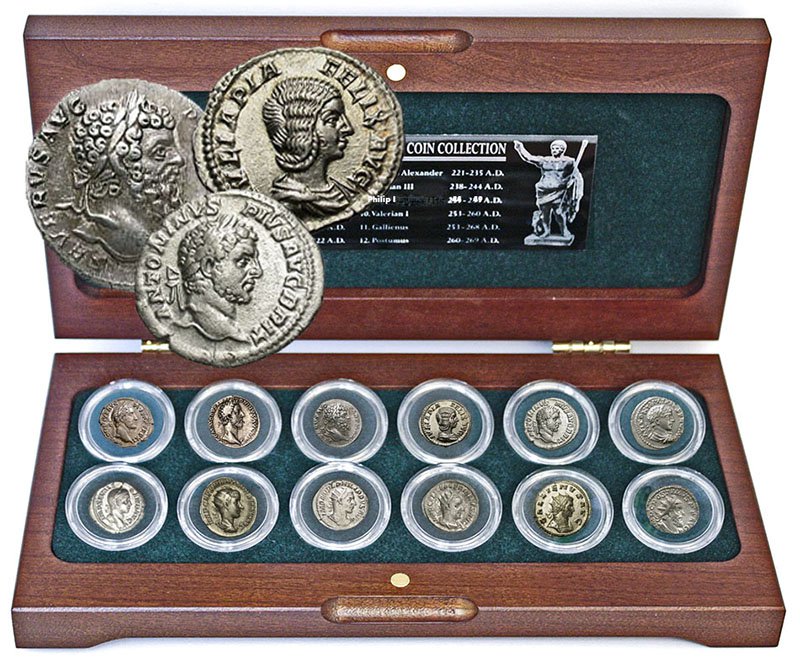
Roman Empire: 12 Emporers Silver Coin Collection
Only 1 available
Details
Shipping: Australia: free (more destinations)
Condition: Brand new
*The store has not been updated recently. You may want to contact the merchant to confirm the availability of the product.
Coin type and grade may vary somewhat from image
These genuine ancient Roman silver coins from the second and third Centuries AD offer a view of the roots of modern
western civilization evident in the Roman Empire. Coins were made by hand by inserting a hot metal blank between two
dies and striking the upper die with a heavy hammer. The resulting coins were often not perfectly round, and often
imperfectly centered. The obverse side of each coin shows the portrait of the emperor or empress at the time the coins were
minted. The reverse sides show images depicting history, military themes and most frequently, mythology. Numerous
pagan gods and goddesses dominated Roman life, which explains the popularity of these themes.
The earlier coins in this collection are known as denarii. The denarius, first minted circa 211 BC, was the principle
currency, serving both the Roman Republic and Imperial Rome for over 400 years. The denarius was modeled after an
earlier coin design, the very popular Greek silver drachm, which first appeared about 300 years earlier. The denarius design
changed little over the centuries until Rome’s growing financial woes caused the denarius to be replaced by the doubledenarius, or antoninianus. After it was first introduced circa 211 AD, this new, larger coin was made of lower grade silver,
and was characterized by the portrait of the emperor wearing a “radiate” crown instead of the usual laurel wreath.
Gradually over the next four decades, inflation and the shortage of silver caused a steady decline in the silver content of the
the antoninianus and as a result, the older, higher quality silver denarii disappeared from circulation. By late in the reign of
Gallienus in the middle of the third century, all that was left of the antoninianus was a tiny bronze coin with a thin silver
wash. There were a few later efforts to revive the “ant” however, Roman silver coins never recovered prominence,
reflecting the empire’s declining power and wealth.
TYPICAL ASSEMBLAGE OF COINS - LIST MAY VARY
1 ANTONINUS PIUS 138-161 A.D. 7 SEVERUS ALEXANDER 221-235 A.D.
2 COMMODUS 177-192 A.D. 8 GORDIAN III 238-244 A.D.
3 SEPTIMIUS SEVERUS 193-211 A.D. 9 Philip I 244-249 A.D.
4 JULIA DOMNA 173-217 A.D. 10 VALERIAN I 253-260 A.D.
5 CARACALLA 196-217 A.D. 11 GALLIENUS 253-268 A.D.
6 ELAGABALUS 218-222 A.D. 12 POSTUMUS 259-268 A.D.
Data:
Box measures: 10.75" x 5.625" x 1.375"
Each coin is protected in
an archival capsule and
beautifully displayed in a
deluxe custom-made
cherry hardwood case. The
case features a rich, forest
green velour-like interior
and an engraved plaque
inscribed with a list of the
coins. The deluxe case and
a certificate of authenticity
come packaged in an
attractive black embossed
gift box.
These genuine ancient Roman silver coins from the second and third Centuries AD offer a view of the roots of modern
western civilization evident in the Roman Empire. Coins were made by hand by inserting a hot metal blank between two
dies and striking the upper die with a heavy hammer. The resulting coins were often not perfectly round, and often
imperfectly centered. The obverse side of each coin shows the portrait of the emperor or empress at the time the coins were
minted. The reverse sides show images depicting history, military themes and most frequently, mythology. Numerous
pagan gods and goddesses dominated Roman life, which explains the popularity of these themes.
The earlier coins in this collection are known as denarii. The denarius, first minted circa 211 BC, was the principle
currency, serving both the Roman Republic and Imperial Rome for over 400 years. The denarius was modeled after an
earlier coin design, the very popular Greek silver drachm, which first appeared about 300 years earlier. The denarius design
changed little over the centuries until Rome’s growing financial woes caused the denarius to be replaced by the doubledenarius, or antoninianus. After it was first introduced circa 211 AD, this new, larger coin was made of lower grade silver,
and was characterized by the portrait of the emperor wearing a “radiate” crown instead of the usual laurel wreath.
Gradually over the next four decades, inflation and the shortage of silver caused a steady decline in the silver content of the
the antoninianus and as a result, the older, higher quality silver denarii disappeared from circulation. By late in the reign of
Gallienus in the middle of the third century, all that was left of the antoninianus was a tiny bronze coin with a thin silver
wash. There were a few later efforts to revive the “ant” however, Roman silver coins never recovered prominence,
reflecting the empire’s declining power and wealth.
TYPICAL ASSEMBLAGE OF COINS - LIST MAY VARY
1 ANTONINUS PIUS 138-161 A.D. 7 SEVERUS ALEXANDER 221-235 A.D.
2 COMMODUS 177-192 A.D. 8 GORDIAN III 238-244 A.D.
3 SEPTIMIUS SEVERUS 193-211 A.D. 9 Philip I 244-249 A.D.
4 JULIA DOMNA 173-217 A.D. 10 VALERIAN I 253-260 A.D.
5 CARACALLA 196-217 A.D. 11 GALLIENUS 253-268 A.D.
6 ELAGABALUS 218-222 A.D. 12 POSTUMUS 259-268 A.D.
Data:
Box measures: 10.75" x 5.625" x 1.375"
Each coin is protected in
an archival capsule and
beautifully displayed in a
deluxe custom-made
cherry hardwood case. The
case features a rich, forest
green velour-like interior
and an engraved plaque
inscribed with a list of the
coins. The deluxe case and
a certificate of authenticity
come packaged in an
attractive black embossed
gift box.
You may also be interested in:
-
$23.77

-
$50.35

-
$475.59
-
$412.71
-
$22.23
-
$22.37
-
$412.71
-
$342.76
-
$454.68
-
$454.68