
$11.54
On Hold
Potato Clock Novel Green Science Educational Experiment Kids Lab Home School Toy
More than 10 available
Details
Shipping: Australia: free (more destinations)
Condition: Brand new
*The store has not been updated recently. You may want to contact the merchant to confirm the availability of the product.
Wholesale Potato Clock Novel Green Science Educational Experiment Kids Lab Home School Toy. MOQ 1 piece.
Shipped in 3 days! Free shipping with Tracking No.
- NO.P201302280041
- Details:
- These simple devices can make the clock work, will you believe it? Why not have a try?
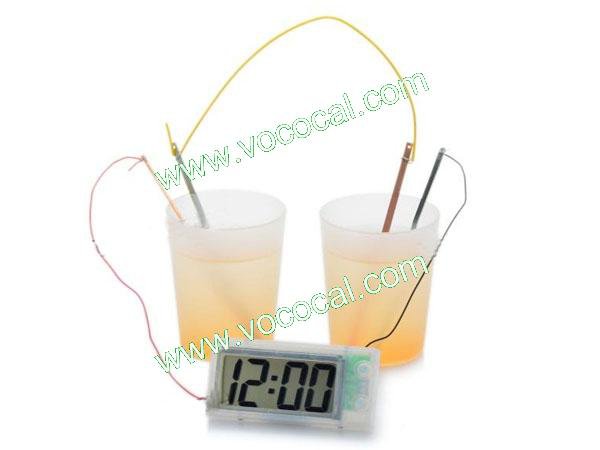
- How to make the clock work: Connect the black wire of the LCD clock (negative) to one of the zinc plates. Then connect the red wire of the LCD clock (Positive) to a piece of copper plate. Now all the components are connected. Insert the copper and zinc plates into the liquid in the cups (as shown in the picture), be sure that the metal plates do not touch each other. The clock will start to work now
- Also, you can replace the liquid and the cups with other battery resources, such as potato, water, juice, lemons, oranges, tomatoes, apples, etc
- For better understanding or fun, you can try other connection ways, maybe put all the zinc plates and copper plates in one cup, etc, what will happen? You may find out the answer
- Do these experiment with your kids, help your kids learn the knowledge of material and energy conversion principle
- Note:1. Potato not included; 2. This product is designed to play and help children to learn more knowledge from the experiment, the time may not really accurate when it is moved
- Package includes:
- 1 x 1.8" electronic display screen
- 1 x Transparent insulation tape
- 2 x Copper strips
- 2 x Zinc strips
- 1 x Connecting cable
- 2 x Experiment cup
- 1 x English / Chinese manual
- How it works:
- 1.The metal strips and liquid make a simple battery that creates electricity to operate the clock. Each cup of liquid works as a device called a electrochemical cell. It converts the chemical energy stored in the metal strips into electrical energy. The liquid are needed to make electricity strong enough to run the clock
- 2.A cell works because of the chemical properties of the metals inside (the copper and zinc). The different properties cause tiny particles charged with electricity (called ions) to move between the the two strips of metal. This flow is an electric current. The liquid contains the particles that allow the current to flow,but it stops the metals touching.Electric current also flows along the wires between the zinc and copper strips and the clock. This current makes the clock work
-
- If your clock produces weak display,try one of the following:
- 1.Wait for a minute, the signal is sometimes weak at the beginning, but gets stronger after a short while
- 2.Examine the metal plates for rust(oxidization). Use sand paper to remove any rust
- 3.Try putting the metal plates closer together(but not touching each other). Conduction will be better if the distance between the plates is shorter.
- 4.If there is no reaction, check all the connection points. Make sure that the connection points are correctly and firmly placed. Also, check if the polarities are correct - make sure that the negative(black wires) and positive(red wires) terminals are connected properly
- 5.Check if the metal plates/wires are touching each other, this causes short circuits
Shipped in 3 days! Free shipping with Tracking No.
- NO.P201302280041
- Details:
- These simple devices can make the clock work, will you believe it? Why not have a try?
- How to make the clock work: Connect the black wire of the LCD clock (negative) to one of the zinc plates. Then connect the red wire of the LCD clock (Positive) to a piece of copper plate. Now all the components are connected. Insert the copper and zinc plates into the liquid in the cups (as shown in the picture), be sure that the metal plates do not touch each other. The clock will start to work now
- Also, you can replace the liquid and the cups with other battery resources, such as potato, water, juice, lemons, oranges, tomatoes, apples, etc
- For better understanding or fun, you can try other connection ways, maybe put all the zinc plates and copper plates in one cup, etc, what will happen? You may find out the answer
- Do these experiment with your kids, help your kids learn the knowledge of material and energy conversion principle
- Note:1. Potato not included; 2. This product is designed to play and help children to learn more knowledge from the experiment, the time may not really accurate when it is moved
- Package includes:
- 1 x 1.8" electronic display screen
- 1 x Transparent insulation tape
- 2 x Copper strips
- 2 x Zinc strips
- 1 x Connecting cable
- 2 x Experiment cup
- 1 x English / Chinese manual
- How it works:
- 1.The metal strips and liquid make a simple battery that creates electricity to operate the clock. Each cup of liquid works as a device called a electrochemical cell. It converts the chemical energy stored in the metal strips into electrical energy. The liquid are needed to make electricity strong enough to run the clock
- 2.A cell works because of the chemical properties of the metals inside (the copper and zinc). The different properties cause tiny particles charged with electricity (called ions) to move between the the two strips of metal. This flow is an electric current. The liquid contains the particles that allow the current to flow,but it stops the metals touching.Electric current also flows along the wires between the zinc and copper strips and the clock. This current makes the clock work
-
- If your clock produces weak display,try one of the following:
- 1.Wait for a minute, the signal is sometimes weak at the beginning, but gets stronger after a short while
- 2.Examine the metal plates for rust(oxidization). Use sand paper to remove any rust
- 3.Try putting the metal plates closer together(but not touching each other). Conduction will be better if the distance between the plates is shorter.
- 4.If there is no reaction, check all the connection points. Make sure that the connection points are correctly and firmly placed. Also, check if the polarities are correct - make sure that the negative(black wires) and positive(red wires) terminals are connected properly
- 5.Check if the metal plates/wires are touching each other, this causes short circuits
Other Products from vococal (View All)
-
$9.89
-
$11.56

-
$12.75

-
$28.34

-
$40.69

-
$16.91

-
$16.09

-
$20.43

-
$14.15

-
$39.13


 CN, Guangdong
