
$27.87
Add to Cart
Original Black Velvet Landscape Painting unknown Artist
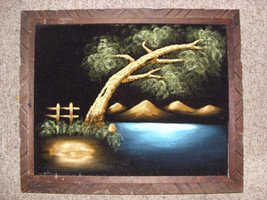
Beautiful landscape on Black velvet in a hand carved wooden frame. This wonderful piece of original art work is a one of a kind, these type pf paintings were popular in the 1960 and 70 as cheap decor and are highly collectible today.
A Modern History of Velvet Paintings that usually went unsigned follows and comes from Wikipedia:
The paintings are widely sold in rural America, and frequently have kitsch themes. They often depict images of Elvis Presley (see Velvet Elvis), Dale Earnhardt, John Wayne, Jesus, Native Americans, wolves, and cowboys, and the colors are often bright and vivid to contrast the dark velvet. They can also include more exotic or avant-garde themes.
Ciudad Juárez, Mexico was a center of velvet painting in the 1970s. A displaced Georgia farmboy, Doyle Harden, was the pioneer who created an enormous factory, where velvets were turned out by the thousands by artists sitting in studios.[citation needed] One artist would paint one piece of the picture, then slide the velvet along to the next artist, who would add something else. Velvet paintings mass produced by hand in this manner fueled the boom in velvet paintings in the 1970s in the United States. Edgar Leeteg has been called "the father of American black velvet kitsch".
This piece measures 22 x 18 1/2 in its frame.
A Modern History of Velvet Paintings that usually went unsigned follows and comes from Wikipedia:
The paintings are widely sold in rural America, and frequently have kitsch themes. They often depict images of Elvis Presley (see Velvet Elvis), Dale Earnhardt, John Wayne, Jesus, Native Americans, wolves, and cowboys, and the colors are often bright and vivid to contrast the dark velvet. They can also include more exotic or avant-garde themes.
Ciudad Juárez, Mexico was a center of velvet painting in the 1970s. A displaced Georgia farmboy, Doyle Harden, was the pioneer who created an enormous factory, where velvets were turned out by the thousands by artists sitting in studios.[citation needed] One artist would paint one piece of the picture, then slide the velvet along to the next artist, who would add something else. Velvet paintings mass produced by hand in this manner fueled the boom in velvet paintings in the 1970s in the United States. Edgar Leeteg has been called "the father of American black velvet kitsch".
This piece measures 22 x 18 1/2 in its frame.


