
$54.56
Add to Cart
Gourmet Pan-Roasted Kamairi Green Tea
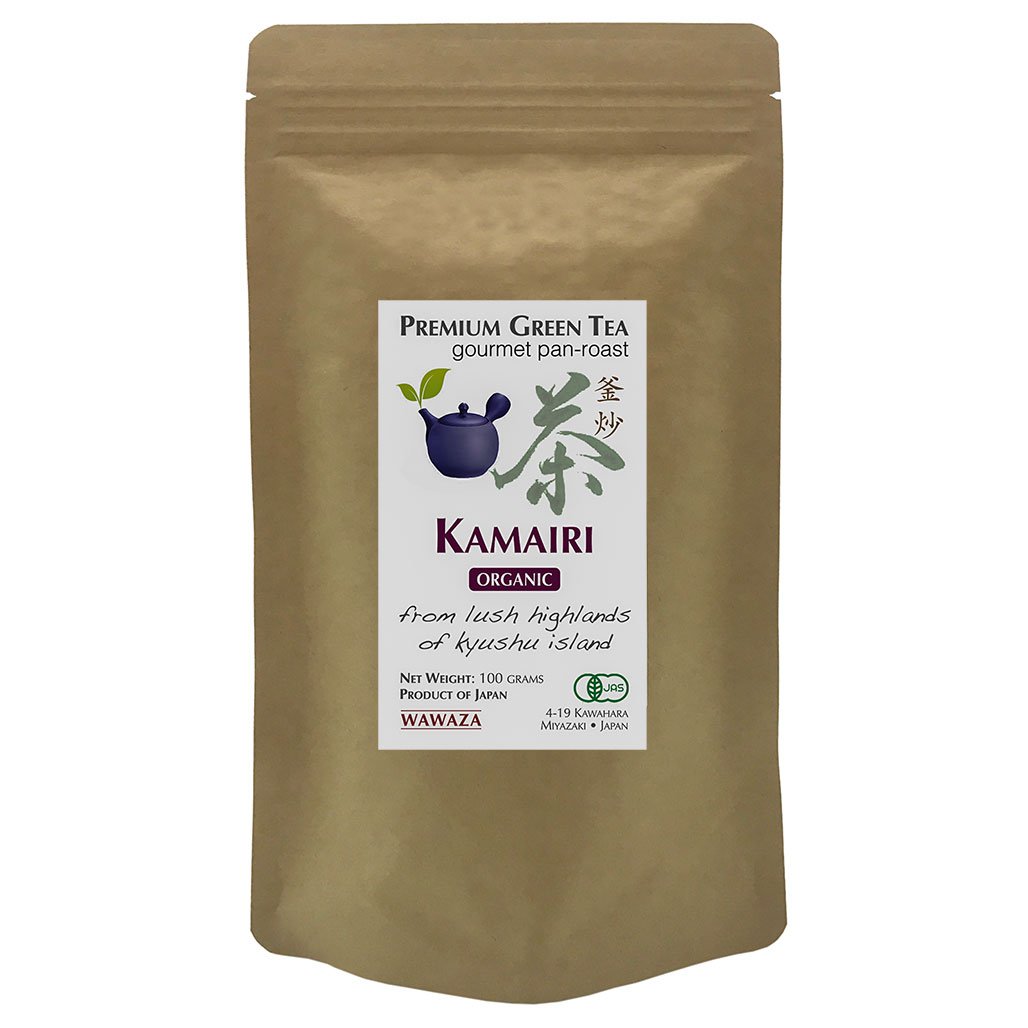


If you are looking to intrigue your palate, give this subtle and sophisticated tea a try.
Winner of UK's "Great Taste" tea competition. Also, an excellent choice for serving on special occasions.
Kamairi in Japanese means roasting in a pan. Fresh tea leaves are dried in heated iron pans immediately after harvest with repeated agitation for about 10 minutes.
The tea maker keeps turning the leaves manually, observing the color and texture. Next, the leaves are rolled and dried in a four-step process. The process is called iriha-ki.
This time-tested Japanese technique enhances tea's savory (umami) content, yielding a complex flavor and rich taste.
Net Weight: 100 grams
Product of Japan
*******************
Type: Loose Leaf Green Tea
Variety: Pan-roasted 'Kamairi'
Region: Hinokage, Kyushu island, Japan
Color: Yellow/green
Flavor: Medium light, moderately sharp and distinct, slightly roasted
*******************
Certified Organic
This tea is certified as organic by the government of Japan. All plant-based organic products produced in Japan must be compliant with Japan Agricultural Standards (JAS). The compliance process includes a rigorous application process as well as regular on-site inspections.
*******************
How to Brew a Perfect Cup (See diagram in picture gallery)
High quality Kamairi teas yield their maximum flavor when brewed at temperatures much lower than boiling, and for less time than other teas. Brew it in water that is too hot or for too long, and the tea will end up tasting bitter.
Hint: Use good water, and a non-reactive kettle. You can’t make good tea with bad water!
Brew Temp: Simmering (not boiling) water. 160-170 °F (70-77 °C).
Brew Time: 2 minutes
How Much: 1 tsp per cup (120 ml)
1 - Add Tea to Teapot
Add tea leaves to the empty teapot. One teaspoonful per cup is sufficient. However, you may adjust the amount depending on your own taste.
2 - Add Near Boiling Water to Cups
Pour hot water from kettle into each cup. Let the water cool down a bit in each cup for about 2 minutes.
3 - Pour Water from Cups into Teapot
Close the lid of the teapot. Let the tea brew for about 2 minutes. You may adjust the time for what suits your palate best. DO NOT stir, shake or mix the tea while brewing.
4 - Serve and Enjoy!
Pour small amounts of tea into each cup at a time, and go around until the very last drop is poured. Japanese firmly believe that the last drop of tea determines its taste as a whole!
You can add hot water again to the teapot for a second, or even a third brewing.
*******************
+++ About Water Quality
If your tap water tastes bad, then so probably will your tea, regardless of its quality!
You should use fresh, good quality water without a lot of minerals (but not distilled water) to get the best flavor out of your tea. If using tap water, let it run cold for at least 10 seconds before using it.
+++ Using a Non-reactive Kettle
Japanese green teas (and indeed all teas,) should be prepared in kettles made from a material that is as non-reactive as possible. The material your kettle is made of can chemically react with water, and cause contamination.
Aluminum kettles should definitely to be avoided. Aluminum is a reactive material which has been proven to cause toxic contamination. Glass, ceramic, stainless steel, enamel, marble or cast iron are excellent non-reactive, non-toxic materials.
*******************
About 'Kamairi' Teas
Kamairi teas account for only about 2% of Japanese tea production, due to unusually high care required in its production process. Fresh tea leaves are immediately parched after harvesting for 10 minutes at 300 degrees C, by a process called "Iriha-ki", to minimize and stop fermentation. Parched leaves are rolled and dried in a four step, intensely manual process. This time-tested Japanese technique yields a unique pan-parched fragrance, with a remarkably complex and rich taste.
Winner of UK's "Great Taste" tea competition. Also, an excellent choice for serving on special occasions.
Kamairi in Japanese means roasting in a pan. Fresh tea leaves are dried in heated iron pans immediately after harvest with repeated agitation for about 10 minutes.
The tea maker keeps turning the leaves manually, observing the color and texture. Next, the leaves are rolled and dried in a four-step process. The process is called iriha-ki.
This time-tested Japanese technique enhances tea's savory (umami) content, yielding a complex flavor and rich taste.
Net Weight: 100 grams
Product of Japan
*******************
Type: Loose Leaf Green Tea
Variety: Pan-roasted 'Kamairi'
Region: Hinokage, Kyushu island, Japan
Color: Yellow/green
Flavor: Medium light, moderately sharp and distinct, slightly roasted
*******************
Certified Organic
This tea is certified as organic by the government of Japan. All plant-based organic products produced in Japan must be compliant with Japan Agricultural Standards (JAS). The compliance process includes a rigorous application process as well as regular on-site inspections.
*******************
How to Brew a Perfect Cup (See diagram in picture gallery)
High quality Kamairi teas yield their maximum flavor when brewed at temperatures much lower than boiling, and for less time than other teas. Brew it in water that is too hot or for too long, and the tea will end up tasting bitter.
Hint: Use good water, and a non-reactive kettle. You can’t make good tea with bad water!
Brew Temp: Simmering (not boiling) water. 160-170 °F (70-77 °C).
Brew Time: 2 minutes
How Much: 1 tsp per cup (120 ml)
1 - Add Tea to Teapot
Add tea leaves to the empty teapot. One teaspoonful per cup is sufficient. However, you may adjust the amount depending on your own taste.
2 - Add Near Boiling Water to Cups
Pour hot water from kettle into each cup. Let the water cool down a bit in each cup for about 2 minutes.
3 - Pour Water from Cups into Teapot
Close the lid of the teapot. Let the tea brew for about 2 minutes. You may adjust the time for what suits your palate best. DO NOT stir, shake or mix the tea while brewing.
4 - Serve and Enjoy!
Pour small amounts of tea into each cup at a time, and go around until the very last drop is poured. Japanese firmly believe that the last drop of tea determines its taste as a whole!
You can add hot water again to the teapot for a second, or even a third brewing.
*******************
+++ About Water Quality
If your tap water tastes bad, then so probably will your tea, regardless of its quality!
You should use fresh, good quality water without a lot of minerals (but not distilled water) to get the best flavor out of your tea. If using tap water, let it run cold for at least 10 seconds before using it.
+++ Using a Non-reactive Kettle
Japanese green teas (and indeed all teas,) should be prepared in kettles made from a material that is as non-reactive as possible. The material your kettle is made of can chemically react with water, and cause contamination.
Aluminum kettles should definitely to be avoided. Aluminum is a reactive material which has been proven to cause toxic contamination. Glass, ceramic, stainless steel, enamel, marble or cast iron are excellent non-reactive, non-toxic materials.
*******************
About 'Kamairi' Teas
Kamairi teas account for only about 2% of Japanese tea production, due to unusually high care required in its production process. Fresh tea leaves are immediately parched after harvesting for 10 minutes at 300 degrees C, by a process called "Iriha-ki", to minimize and stop fermentation. Parched leaves are rolled and dried in a four step, intensely manual process. This time-tested Japanese technique yields a unique pan-parched fragrance, with a remarkably complex and rich taste.


 JP, Miyazaki
